A pier and beam foundation is a construction method used to elevate a house structure above ground level using vertical support piers and horizontal beams as the main load-bearing system. This setup keeps the floor from sitting directly on the soil or a concrete slab, instead placing it above an open space known as a crawlspace.
A crawlspace is a shallow, narrow space beneath the ground floor of a house built above the soil. It provides access to the underside of the home for structural inspections, plumbing repairs, electrical wiring, HVAC systems, and other utilities. The height of a crawlspace can vary depending on the home’s design, the age of the building, and local construction standards. Typically, it’s built just high enough for a person to enter and carry out inspections or repairs.
The pier and beam system was commonly used in homes across the United States in the 1950s, including in areas like Dallas and North Texas, before slab-on-grade foundations became the standard due to post–World War II demands for faster and more cost-efficient construction. While many homes today use slab foundations, plenty of people still choose pier and beam for custom builds, historic renovations, and properties that need easy access to utilities beneath the floor.
The main difference between the two is that a slab-on-grade foundation is a shallow system made of reinforced concrete poured directly on the ground, while a pier and beam foundation transfers the building load through the floor framing to the main beams, then down to the support piers and the soil beneath.
This pier and beam foundation system works well in areas like Dallas and North Texas, where expansive clay soil is common. Clay tends to swell when it holds moisture and shrink when it dries out. These shifts in soil volume can cause a foundation to move, settle, tilt, or become uneven. That’s why pier and beam is often preferred—it’s easier to inspect and repair since everything is accessible through the crawlspace.
Why Pier and Beam is Common in Dallas and North Texas
The pier and beam system is a traditional construction method widely used in wood-frame homes and low-rise buildings in the United States. It’s commonly chosen because the construction is relatively straightforward, the materials are easy to source, and it works well for homes that need airflow and utility access beneath the floor.
In the Dallas–Fort Worth area, pier and beam foundations are commonly found in older homes in neighborhoods like East Dallas, Oak Cliff, Lakewood, Bishop Arts, older parts of Highland Park, and other historic areas. Many of these homes were built in the early to mid-20th century, when pier and beam was still a standard foundation method for residential construction.
One reason the pier and beam system is still used today is that many areas in North Texas have expansive clay soil that’s highly sensitive to moisture levels. During rainy periods, the soil absorbs water and expands. In long, dry summers, it loses moisture, shrinks, and can crack. In contrast, homes built on slab foundations can experience cracking or uneven settling of the concrete when the soil shifts. This cycle repeats year after year and can put significant stress on a home’s foundation.
That’s why the pier and beam system is still used today. Even so, it requires consistent maintenance, especially when it comes to drainage, moisture control, and the condition of the wood components beneath the house.
How a Pier and Beam Foundation Works
A pier and beam foundation consists of several main components that support the structure, including piers, beams, joists, the subfloor, and the crawlspace.
Here is a breakdown of the core components:
- Piers are vertical support columns that serve as the main load-bearing points of the foundation. They can be made from poured concrete, concrete blocks, brick, steel, or helical pier systems. In older homes around Dallas, it’s still common to find piers made of brick or concrete blocks. Today, contractors typically use concrete piers, steel piers, or helical piers for foundation repairs, depending on soil conditions, structural design, and the level of damage.
Piers usually rest on footings, concrete pads, or deeper, more stable soil layers to help distribute the building’s load more evenly and provide better support. - Beams are the main horizontal members installed on top of the piers. They are typically made from heavy timber, although in some cases they may be reinforced with steel or other materials. Beams carry the load from the floors and walls of the house and transfer it down to the piers.
- Joists are smaller floor framing members installed across the beams. They support the subfloor, which is the base layer of the home’s flooring system. If the joists weaken, sag, or begin to rot, the floor can feel uneven, sloped, or overly bouncy when walked on.
- The subfloor is the base layer of flooring installed on top of the joists. It’s the surface where finished flooring like hardwood, vinyl, tile, or carpet is placed. The condition of the subfloor is heavily influenced by the strength of the joists and the moisture levels in the crawlspace.
- As for the crawlspace, as mentioned earlier, it’s the open space beneath the house and a defining feature of a pier and beam foundation. This area often becomes a source of problems if it’s damp, poorly ventilated, exposed to rainwater intrusion, or lacks proper moisture protection.
Here’s the load path in a pier and beam foundation system:
floor → subfloor → joists → beams → piers → footing or supporting soil
Because of this, the overall strength of the system depends heavily on how well the wood framing, the piers, and the underlying soil conditions all work together.
Below, we’ll take a deeper look at how the pier and beam foundation system works.
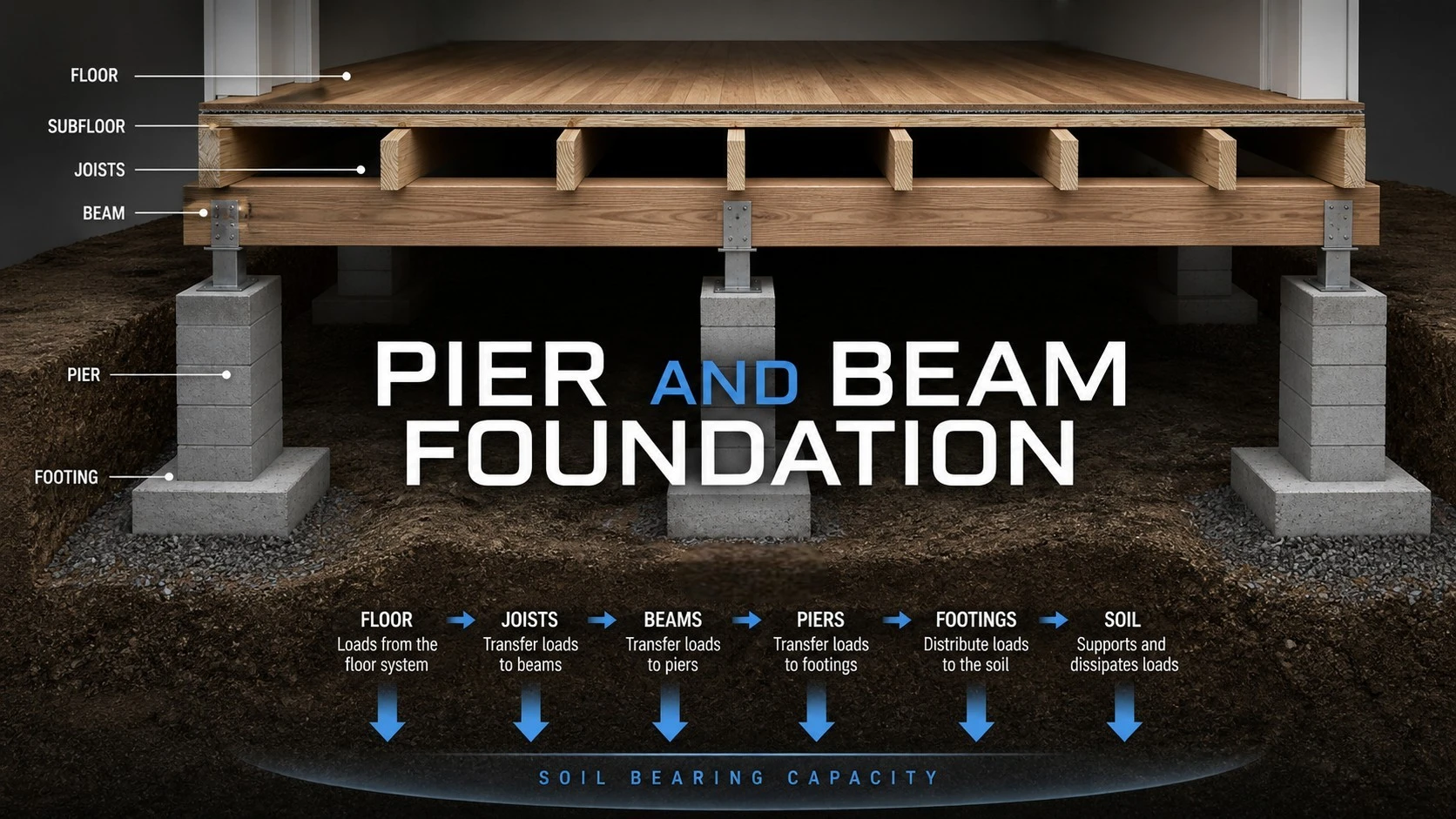
The mechanism of a pier and beam foundation depends on the way the floor framing, main beams, support piers, and supporting soil work together. This foundation transfers the building load to specific support points, rather than across the entire ground surface. When there is load on the floor, that load is carried by the joists, then transferred to the beams. From the beams, the load moves down to the piers, and finally to the footings or the soil beneath them.
The downside is that if the soil beneath one of the piers shrinks or loses its bearing capacity, that pier can settle. As a result, the floor above it may also drop. This often leads to uneven floors, doors that won’t close properly, windows that stick, or cracks forming in interior walls.
On the other hand, when the soil expands from absorbing moisture, a pier can be pushed upward. This can cause one side of the house to lift while another side stays in place or even settles. This condition is known as differential movement, or uneven foundation movement.
No need to worry—this can be corrected by readjusting the support points. Contractors typically use jacks to slowly lift the affected area of the house, then add shims between the pier and the beam. This process is known as shimming or reshimming.
If the existing piers are damaged, leaning, settled, or no longer able to support the load, they can be replaced or supplemented with new ones. If beams or joists are compromised due to moisture, termites, or wood rot, those components need to be reinforced or replaced.
In most cases, improving drainage is also necessary to address the root cause and prevent the foundation movement from happening again. Poor drainage is also one of the main causes of damage in pier and beam foundations. Water from the roof, yard, or downspouts that drains toward the house can end up entering the crawlspace. If left unchecked, the soil beneath the home can become overly saturated, causing piers to shift and the wood structure to start deteriorating.
In short, the strength of a pier and beam system depends on how all its components work together. If one part weakens, the entire foundation can become unbalanced.
Signs Your Pier and Beam Foundation Needs Repair:
Over time, soil movement and moisture can take a toll on your foundation. If you notice any of the following signs, it’s time to call a professional: Doors and windows that stick or won’t close properly. Uneven, sagging, or bouncy floors. Cracks in the drywall, especially around door frames and windows. Musty odors or visible dampness coming from the crawlspace.
How to Repair a Pier and Beam Foundation
Proper repair starts with identifying the root cause of the problem. Not every sloped floor means you need new piers, and not every crack indicates a total foundation failure. That’s why an initial inspection is critical before deciding on the right repair approach.
Here are some common pier and beam foundation issues and how to fix them:
- The most common repair is shimming, or reshimming. In this process, contractors place thin plates (usually steel or another hard material) between the pier and the beam. This is to close the gaps and bring the floor back to level where it has settled. Shimming works for minor adjustments, but it won’t fix the issue if the real cause is ongoing soil movement or poor drainage.
- If the home has experienced significant settling, leveling may be needed. This involves slowly lifting the house at specific points using jacks. Once the floor is brought back to the correct position, the contractor will install shims, reinforce the beams, or add new piers. The leveling process has to be done carefully to avoid putting too much stress on the walls, flooring, plumbing, or other structural components.
- If the existing piers are no longer in good condition, then pier replacement or pier addition is needed. Old piers can be replaced with concrete piers, steel piers, or helical piers. Contractors typically use concrete piers, while steel or helical piers are chosen when deeper support, higher load capacity, or better performance in certain soil conditions is required. The choice of pier type is usually based on inspection results and structural needs, not just cost.
- If the damage is in the wood components, repairs may involve beam replacement, joist repair, or sistering. Sistering is a method where a new joist or beam is installed alongside the existing one to reinforce the structure without having to remove the entire original piece. This approach is often used when part of the joist is still in decent condition but needs additional support.
- If the root of the problem is water, then foundation repair needs to go hand in hand with drainage correction. This can include installing a French drain, adjusting the grading around the house, extending downspouts, adding a sump pump, or redirecting water flow away from the structure. Without fixing the drainage, even a leveled foundation can start moving again as the soil moisture changes.
- If the issue is caused by moisture, then crawlspace encapsulation may be needed. This system seals off the crawlspace using a vapor barrier and protective materials to reduce moisture coming up from the soil. Encapsulation helps keep the wood dry and lowers the risk of mold, musty odors, wood rot, and excess humidity.
Before making any pier and beam repairs, you need to look at the foundation system as a whole. If you’re not sure what you’re looking at, it’s best to consult an experienced contractor.
Homeowners comparing Foundation Repair Dallas companies should look for proven experience with pier-and-beam systems, expansive clay soil, drainage problems, and structural leveling.
Estimated Cost of Pier and Beam Repair
The cost of pier and beam repair can vary widely depending on your location, the size of the home, the level of damage, crawlspace access, the number of affected piers, the condition of the wood beams, the type of piers used, and whether there are drainage or moisture issues.
The cost ranges below generally apply to the Dallas area.
- In Dallas, for minor repairs like reshimming and basic leveling, costs typically start around $2,000. These types of repairs are usually done when the floor has a slight slope, there are small gaps between the pier and beam, or doors are starting to stick. The cost can go lower or higher depending on how many areas need adjustment and how easy it is to access the crawlspace.
- For more extensive leveling, the cost can increase since more areas of the house need to be lifted and adjusted. In Dallas, this type of work typically runs around $5,000-$10,000. If the job involves multiple rooms, many support points, or a structure that has been shifting for a long time, the process will take longer and cost more.
- For pier addition or replacement, the cost depends heavily on the type of pier used. Concrete piers are usually the more affordable option, typically ranging from $300 to $800 per pier in Dallas. Steel piers generally run about $1,000 to $2,000 each, while helical piers are usually around $1,500 and $3,000 or more. Steel and helical piers tend to cost more because of differences in materials, installation depth, methods, and load capacity. That’s why the cost per pier can vary quite a bit depending on the type used.
- For beam replacement, the cost depends on the length of the beam, the condition of the crawlspace, how easy it is to access, and whether other areas are affected. If the beam is damaged due to wood rot or termites, the cost can increase since the joists, subfloor, or other framing components may also need repair.
- Drainage repairs such as installing a French drain, adding surface drains, regrading the yard, or extending downspouts can also add to the overall cost. However, this work is often essential since water is one of the main causes of pier and beam foundation problems.
In Dallas, a French drain typically costs around $25–$35 per linear foot, including excavation labor, perforated pipe, and gravel. Surface drain systems usually run about $2,200–$3,800, depending on the number of catch basins and how complex the layout is. Regrading generally costs around $1,100–$3,300 for an average yard, or roughly $1 to $2 per square foot. - For crawlspace encapsulation, the cost depends on the size of the home, the condition of the crawlspace, the type of vapor barrier used, whether a dehumidifier is needed, and the overall moisture control system installed. In Dallas, contractors typically charge around $3 to $7 per square foot.
- For major repairs, the total cost of pier and beam work in Dallas can reach tens of thousands of dollars, especially if the damage involves multiple piers, main beams, joists, drainage issues, and severe moisture problems. For new construction using a pier and beam system, foundation costs are typically based on the size of the home, structural design, soil conditions, engineering requirements, materials, and overall construction complexity.
Note: For a more detailed cost breakdown, it’s best to speak with an experienced foundation contractor in your area. Make sure you choose someone with a strong reputation, proven experience, and a track record you can trust.
Pier and beam foundations need regular maintenance. You want to make sure rainwater drains away from the foundation. Gutters should be working properly, downspouts shouldn’t discharge water right next to the house, and the soil grading should slope away from the structure. Water pooling around the foundation can make the soil unstable and increase the risk of pier movement.
The crawlspace should also be checked on a regular basis. Make sure the area under the house stays dry, has no musty smell, no standing water, and no signs of termites or wood rot. The vapor barrier should be kept in good condition so ground moisture doesn’t rise into the wood structure.
During the summer, be careful when using a foundation watering system so water doesn’t end up entering the crawlspace.
With proper maintenance, good water management, and repairs that address the root cause, a pier and beam system can be a strong, flexible, and long-lasting foundation. Regular checks also help make sure the soil, moisture levels, wood components, and support points stay stable and solid.