
- Types of Government Contracts You Can Bid for in Texas
- Contract Types
- Residential Contracts
- Commercial Contracts
- Industrial Contracts
- Painting Contracts
- Electrical Contracts
- Wood & Lumber Contracts in Texas
- Registering on the Texas Centralized Supplier List
- Qualifying as a Historically Underutilized Business
- Statewide Procurement Division Certification Process
- Texas Secretary of State HUB Program
- Understanding Texas Bidding Requirements
- Developing a Winning Bid Proposal
- Navigating the Procurement and Award Process
- Partnering with Prime Contractors
- Utilizing State Resources for Small Businesses
- Compliance and Performance Monitoring
- Expanding to Federal and Local Government Contracts
- Frequently Asked Questions

Bidding for government contracts in Texas is a great way for businesses to expand and secure a stable income. The state government spends billions of dollars annually on goods and services. This creates a highly competitive but profitable market for suppliers. In fact, the state of Texas awards over $20 billion in state contracts every single year. Whether a company is a small business, a minority-owned enterprise, or a large corporation, understanding the tender process will give them an edge in winning the contracts that matter most.
Types of Government Contracts You Can Bid for in Texas
The first step in securing government contracts is identifying the right opportunities. In Texas, state agencies regularly publish tenders for a wide range of goods and services, giving contractors the ability to target projects that match their expertise and scope.
One of the key platforms is the Texas Electronic State Business Daily, or ESBD, where most state-level procurement opportunities are listed. In addition, contractors can explore SAM.gov, local government websites, and city procurement portals to track both active and upcoming projects at the state and federal levels.
For companies offering construction estimating services Texas, staying updated with these platforms is essential. It enables faster bid preparation, accurate cost planning, and stronger positioning when competing for high-value contracts.
Once the right opportunities are identified, the next step is understanding the different types of government contracts available in Texas. Each category requires a specific estimating approach, scope understanding, and bidding strategy.
Contract Types
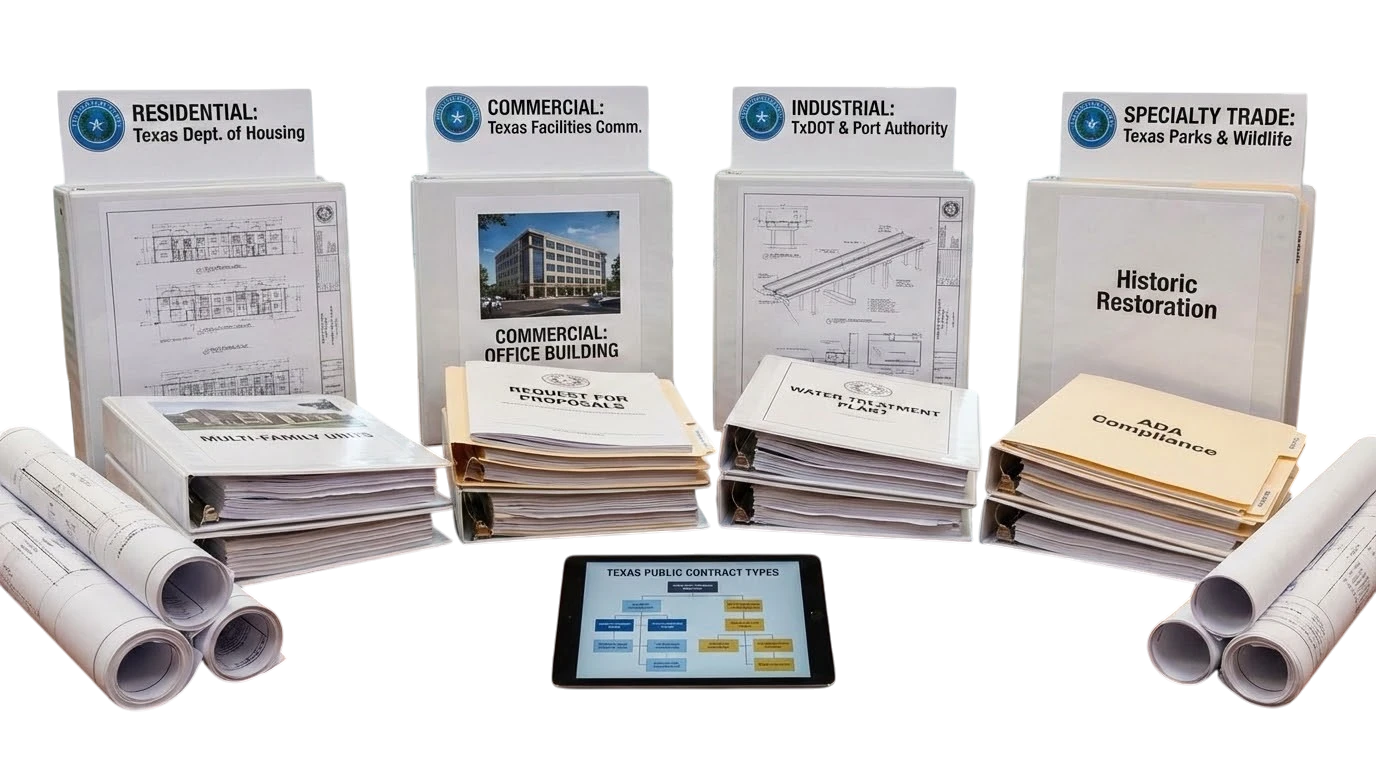
Residential Contracts
Government residential projects in Texas include housing developments, renovations, and public housing upgrades funded by state and local agencies. Contractors who rely on residential estimating Texas gain a strong advantage by submitting accurate material takeoffs and cost projections. Precise estimates help ensure competitive bids while maintaining profitability, especially in projects involving multi-family housing or community development.
Commercial Contracts
Commercial government contracts involve offices, schools, hospitals, and municipal buildings. These projects require detailed scope analysis and strict compliance with regulations. Using Texas commercial estimating allows contractors to break down costs efficiently, covering materials, labor, and timelines. Accurate estimates are crucial for winning bids in this highly competitive sector where margins and timelines are tightly controlled.
Industrial Contracts
Industrial projects include warehouses, manufacturing plants, and infrastructure-related facilities. These projects are complex and require in-depth cost planning. Contractors working on such projects depend heavily on industrial estimating to handle large-scale quantities, specialized materials, and labor-intensive scopes. A well-prepared estimate ensures better risk management and higher chances of contract approval.
Painting Contracts
Government painting contracts typically involve maintenance, renovations, and new construction finishing work. From schools to public offices, these projects require detailed surface area calculations and material planning. By using painting estimating, contractors can accurately forecast paint quantities, labor hours, and equipment costs, helping them submit precise and competitive bids.
Electrical Contracts
Electrical government contracts cover installations, upgrades, and maintenance of public infrastructure systems. These projects require strict adherence to codes and technical specifications. Contractors using electrical estimating can ensure accurate calculations of wiring, fixtures, panels, and labor costs. This level of precision significantly improves bid success rates.
Wood & Lumber Contracts in Texas
Wood-related government contracts include framing, carpentry, and structural work in public projects. These scopes require accurate quantity takeoffs for lumber, fasteners, and related materials. With lumber takeoff Texas or wood estimating service, contractors can avoid material shortages and overestimation, leading to more competitive and reliable bids.
Registering on the Texas Centralized Supplier List
The Centralized Master Bidders List, or CMBL, is a list of suppliers qualified to bid for state contracts. To successfully secure state contracts, getting registered on the CMBL is a crucial first step. Joining this list puts a business directly in front of state purchasing agents. Registered vendors automatically receive email alerts for new bidding opportunities that match their products or services.
- Vendors just need to visit the Texas Comptroller website to complete the online application.
- The process requires basic business structure details and a clear outline of company capabilities.
- Paying the annual registration fee keeps the profile active and ensures the business stays visible for relevant tenders.
Qualifying as a Historically Underutilized Business
The Historically Underutilized Business, or HUB, program is designed to help minority-, women-, and disabled veteran-owned businesses secure state contracts. Texas takes this initiative seriously and sets specific annual spending goals. For example, the state actively aims to award 21.1 percent of building construction contracts and 26 percent of all other services contracts to HUB-certified vendors. This HUB certification is vital because of the exclusive contracts, networking events, and skills acquisition opportunities that come with it.
For a business to qualify, the following criteria must be met:
- The company must be at least 51 percent owned by an eligible minority, woman, or disabled veteran.
- The business must have its principal office located in Texas.
- The owners must actively manage the daily operations of the company.
A HUB certification instantly boosts a company’s reputation and competitive edge in the government contracting sector.
Statewide Procurement Division Certification Process
The Statewide Procurement Division manages Texas procurement policies and approves vendors in the state. To be an authorized vendor, businesses need to adhere to state requirements and register with the Texas Comptroller Vendor Performance Tracking System. Securing certification from the SPD makes it possible for firms to tender for more profitable projects. It also creates a channel where a business can secure faithful suppliers for a long period. Vendors are required to be solvent, be well-versed in a particular sector, and comply with state procurement regulations.
Texas Secretary of State HUB Program
The Texas Secretary of State works to ensure fair competition in the state contract market. This initiative primarily focuses on boosting and reinforcing the status of minority and small businesses. It provides support through:
- Offering educational materials and training sessions about the government bidding process.
- Hosting outreach events to connect businesses directly with state buyers.
- Encouraging government agencies to award a larger percentage of their contracts to HUB-certified vendors.
By joining the program, businesses can improve their chances of being noticed by the government and securing contracts.
Understanding Texas Bidding Requirements
Once the decision to bid has been reached, the business should get a clear understanding of Texas procurement rules. All bids have specific eligibility standards:
- Proper licensing and certification mandates.
- Strict financial and insurance obligations.
- Full compliance with state labor and safety regulations.
Thoroughly reviewing bid documents ensures that businesses meet all eligibility standards before investing time and resources into the application process.
Developing a Winning Bid Proposal
Submitting a strong proposal is the most important step in receiving a government contract. A winning bid must cover several critical points:
- Compliance with Specifications: The bid must clearly show that the bidder meets all project requirements.
- Competitive Pricing Strategy: The vendor should offer a great balance of cost and quality.
- Capability Statement: This section highlights past experience and shows exactly how that background relates to the project.
- Formatting: A document that is clear, short, and meets submission standards.
The proposal must also comply with all procurement laws. Additionally, companies must execute a bid analysis to discover if a contract is a good fit for their current capacities and resources.
Navigating the Procurement and Award Process
From the moment a tender is handed in, the procurement moves through the following stages:
- Evaluation: The government reviews proposals to check qualifications, pricing, and compliance.
- Negotiation: Some contracts require further discussions regarding the final terms and the exact project scope.
- Award Notification: The award is given to the winner, and the contract is sent with instructions on how it will be implemented.
It is good to remember that understanding the evaluation criteria and staying in contact with procurement officials will increase the chances of winning contracts.
Partnering with Prime Contractors
Small businesses that are uncertain about their capacity to take up large contracts should consider subcontracting with well-established suppliers. Partnering with a prime contractor helps smaller firms in a few key ways.
- They gain valuable experience working on specific parts of a larger contract.
- They get the chance to connect with state procurement officials and build successful relationships.
- They build trust and a solid track record for future direct contract bids.
Having contacts among leading contractors at industry events opens the door for short- and long-term projects, resulting in more subcontracting opportunities.
Utilizing State Resources for Small Businesses
The government of Texas has put in place several instruments to assist small businesses in the competition for securing contracts. Among these programs are:
- The Texas Small Business Development Center, which delivers excellent training and financial consultancy.
- The Procurement Technical Assistance Center, which offers free government contract consulting.
- The Texas Comptroller Vendor Liaison Program, which helps vendors easily comply with complex procurement rules.
With the help of such tools, a company can secure a contract and run it smoothly.
Compliance and Performance Monitoring
Getting a government contract is just the initial step. Businesses should follow the terms, reporting requirements, and performance benchmarks of the contract. The performance of vendors in Texas is controlled by state agencies through:
- Regular audits and progress reports.
- Quality assurance reviews and inspections.
- Vendor performance ratings on the state tracking system.
Being compliant is a must if the firm desires to continue its relationship with the state and obtain its next contracts.
Expanding to Federal and Local Government Contracts
After a company has become successful in securing state contracts, it can extend its business to the federal and local markets. The strategies for expansion include:
- Registering with SAM.gov for federal contracts.
- Applying for 8(a) and Women-Owned Small Business certifications through the Small Business Administration.
- Building relationships with local municipalities for city and county contracts.
By introducing various types of contracts, businesses can build a strong revenue stream and successfully break into new markets.
Frequently Asked Questions
1. How long does it take to get HUB certified in Texas?
It typically takes around 60 to 90 days to get HUB certified through completion of the entire application process.
2. Do I need to be on the CMBL to bid for Texas contracts?
Although it is not a prerequisite, being on the CMBL not only helps increase visibility but also enhances the chances of winning state contracts.
3. Can out-of-state businesses bid for Texas government contracts?
They can. However, Texas-based HUB companies are often preferred in some contracts and may therefore have an advantage.
4. What is Texas SmartBuy and how can I register?
Texas SmartBuy is an online purchasing system where state agencies procure goods and services. Vendors can register through the Texas Comptroller website.
5. How can I improve my chances of winning a government contract?
You can increase the likelihood of winning a government contract by complying with the bid requirements, presenting competitive pricing, and displaying experience and available resources in the proposal.