
- What Is “Real Estate,” Exactly?
- The Main Types of Real Estate
- How Real Estate Really Works
- What Actually Drives Property Value
- Who’s Involved When You Buy a Home
- The Step-by-Step Purchase Timeline
- Paying for Your Home and the Help That May Be Available
- Real Estate as an Investment
- Hands-On Ways to Invest
- More Passive or Low-Maintenance Options
- Financing and Managing Risk as an Investor
- Common Terms Every Buyer, Seller, and Investor Should Know
- Smart Upgrades: Sustainability and Resilience
- Bottom Line
Real estate touches almost every part of our lives, from where we sleep, to how local schools get funded, to where businesses decide to grow. If you’re thinking about buying a home, adding a rental to your portfolio, or just trying to make sense of all the jargon, this guide breaks down the basics in plain English.
We’ll walk through what real estate really is, the main types of properties, how a deal actually goes from offer to closing, some popular ways to invest (both hands-on and hands-off), and a quick glossary of terms you’ll run into again and again.
What Is “Real Estate,” Exactly?
Real estate refers to land and anything permanently attached to it including homes, buildings, improvements, and the rights that come with ownership.
In everyday use, you’ll hear “real estate” and “real property” used interchangeably. (That’s different from personal property, like your car or furniture, which isn’t affixed to land.)
Ownership typically includes a “bundle of rights,” such as the right to use, lease, sell, or improve the property within the limits of law and zoning. Those rights have value; how much value depends on location, local demand, condition, allowed uses, and broader economic forces like interest rates.
Etymology & First Use:
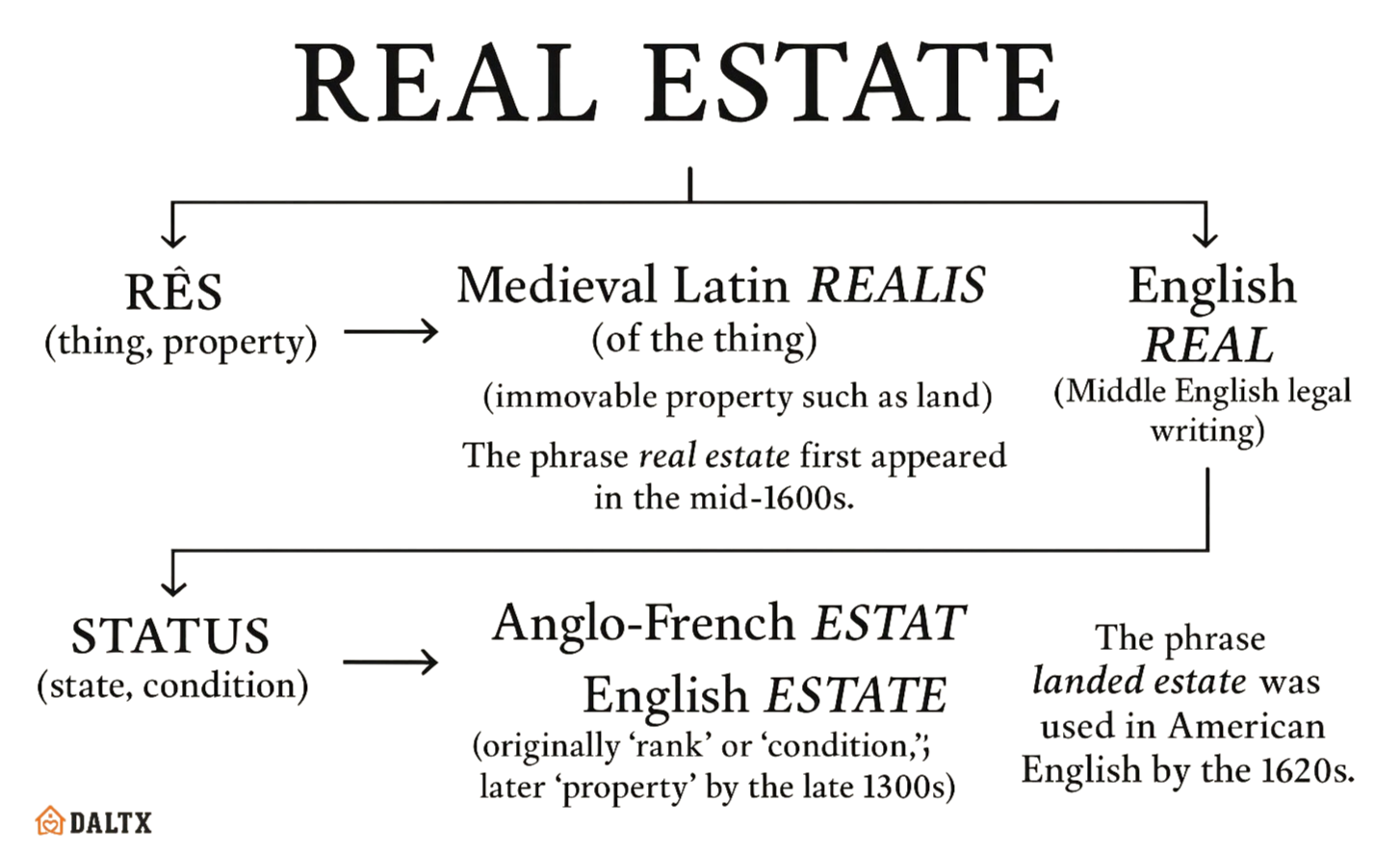
- “Real” comes from the Medieval Latin realis (“of the thing”), which itself comes from the Latin rēs (“thing” or “property”). In English legal writing dating back to Middle English, real referred to “things” in the legal sense, especially immovable property like land, as opposed to personal (movable) goods. The exact phrase real estate first appeared around the mid-1600s.1
- “Estate” comes from the Anglo-French estat, which comes from the Latin status meaning “state” or “condition.” In English, it originally meant “rank” or “condition,” and by the late 1300s, it also came to mean “property.” The phrase “landed estate” was already used in American English by the 1620s.2
The earliest recorded use of “real estate” dates back to the mid-1600s. Merriam-Webster lists its first known use around 1642, while the Online Etymology Dictionary traces it to the 1660s. Either way, the term clearly entered English in the 1600s and has kept its legal tone ever since.3
The Main Types of Real Estate
Understanding the different categories helps you compare apples to apples when buying, investing, or analyzing the market.
- Residential: Includes single-family homes, townhomes, condos, duplexes, triplexes, fourplexes, and manufactured homes.
- Commercial: Covers offices, retail spaces, hotels, and other properties that mainly generate business income.
- Industrial: Includes warehouses, distribution centers, manufacturing facilities, and flex spaces.
- Land: Refers to raw land, infill lots, farmland, and parcels set aside for future development.
- Special purpose & mixed‑use: Properties like self-storage facilities, medical and educational buildings, or developments that combine residential, retail, and office spaces.
How Real Estate Really Works
To understand real estate, it helps to start with what actually drives value in the market.
What Actually Drives Property Value
Three big levers influence property values:
- Location & land use: Zoning, school districts, commute times, and neighborhood amenities.
- Supply and demand: How many homes are for sale or lease versus the number of qualified buyers or tenants.
- Money & macroeconomics: Mortgage rates, employment, local growth, insurance costs, and property taxes.
Who’s Involved When You Buy a Home
- You and the seller
- Real estate agents/brokers representing each side
- A lender (if you’re financing) and an appraiser
- A home inspector and sometimes specialists (e.g., roof, sewer)
- A title/escrow company or real estate attorney (varies by countries and state)
The Step-by-Step Purchase Timeline
- Budget and preapproval
Get preapproved to understand how much home you can afford and to make your offer stronger. - Home search & pricing
Your agent will use comparable sales (comps) and a Comparative Market Analysis (CMA) to help you decide on a fair offer price. - Offer, earnest money & contingencies
Your written offer usually includes an earnest money deposit (typically around 1–3% of the purchase price) and contingencies for financing, appraisal, and inspection. The home inspection contingency gives you time to inspect the property and renegotiate or cancel if serious issues surface. This window is usually 7–10 days, as agreed in the contract. - Appraisal & underwriting
The lender orders an appraisal to confirm the property’s value. Meanwhile, underwriters review your income, assets, debts, and details about the property before final approval. - Title search & escrow (two meanings)
- Escrow in the transaction: A neutral third party holds funds and documents and coordinates closing once the title is cleared.
- Escrow account for taxes/insurance: After you buy the home, many lenders collect part of your annual property taxes and homeowners insurance with each mortgage payment, then pay those bills for you. Some borrowers who qualify can request an escrow waiver and handle those lump-sum payments themselves, though eligibility, fees, and rules vary by lender, loan type, state law, and borrower profile.
- Closing
You’ll sign the final documents, pay your closing costs and down payment, and get the keys once the transaction is officially recorded.
Paying for Your Home and the Help That May Be Available
- Conventional, FHA, VA, USDA and other mortgages are common choices. Some lenders and programs allow down payment assistance (DPA) through grants or second‑mortgage options (forgivable, deferred, or low‑interest), or matched‑savings programs, to help cover your down payment and/or closing costs. Many programs look for a minimum credit score (often ~620), income limits, and completion of a home buyer education course; specifics differ by state and program.
- After you build equity, some owners tap a home equity line of credit (HELOC) for renovations or debt consolidation. Many HELOCs offer a draw period followed by a repayment period, and some lenders provide options to fix the rate on a portion of what you draw, useful when rates are rising. Remember: your home is collateral, so borrow carefully.
Real Estate as an Investment
Real estate can provide cash flow, appreciation, and potential tax benefits, but it also comes with market, maintenance, and regulatory risks.
Here are common ways Americans invest, from hands‑on to fully passive.
Hands-On Ways to Invest
- Buy‑and‑hold rentals (single‑family or small multifamily)
You purchase a property and rent it to long‑term tenants. Key metrics:- Net Operating Income (NOI) = rent & other income − operating expenses (excluding mortgage).
- Cap rate = NOI ÷ purchase price.
- Cash‑on‑cash return = annual pre‑tax cash flow ÷ total cash invested.
Quick example: If rent is $2,200/month, annual gross rent is $26,400. After a 5% vacancy allowance ($1,320) and $8,000 in annual expenses, NOI is $17,080. On a $280,000 purchase, the cap rate is about 6.1%.
If you buy a property with tenants in place, you’ll step into landlord duties immediately and must honor existing leases and local landlord‑tenant laws; rent control or “just cause” rules in some areas may limit rent increases or eviction without cause.
- Short‑term rentals (STRs) / Airbnb
STRs can earn a higher nightly rate than long‑term leases, but occupancy is less predictable and operating costs (furnishings, utilities, cleanings, property management) are higher. Expect more day‑to‑day involvement and be sure you understand local STR rules before you buy. - House hacking
Live in one unit and rent out the others (or rooms) to offset the mortgage. It’s a popular on‑ramp to investing. - Fix‑and‑flip / BRRRR (Buy, Rehab, Rent, Refinance, Repeat)
You add value through renovations. Success hinges on accurate ARV (after‑repair value) estimates, rehab budgets, holding cost assumptions, and a realistic timeline. - Foreclosures and REOs
You can buy at auction (generally as‑is and often cash‑heavy) or purchase bank‑owned (REO) homes through agents after they don’t sell at auction. Preforeclosures and short sales are additional paths, though lender approvals can lengthen timelines. With any distressed property, insist on a careful inspection when possible and budget for repairs. - Tax lien investing
Instead of buying the house, you may purchase a tax lien certificate when an owner falls behind on property taxes. The investor pays the delinquent taxes and then collects repayment (plus interest/penalties) from the owner, or in rare cases, by foreclosing if the owner doesn’t redeem in time. Rules, rates, and timelines vary widely by state, and due diligence is critical. - Partnerships and small syndications
Partnering lets you combine cash, credit, skills, and time. It can also split profits and introduce differences in work styles, so set roles and expectations in writing. You’ll find potential partners via local investor clubs, online communities, crowdfunding platforms, and your professional network.
More Passive or Low-Maintenance Options
- REITs (Real Estate Investment Trusts)
Public or private companies that own or finance real estate; investors buy shares and receive dividends. - MBS (Mortgage‑Backed Securities)
Bonds backed by pools of mortgages; investors earn from borrowers’ payments. Like all bonds, MBS carry interest‑rate and credit risks. - Crowdfunding & real estate funds
Platforms pool investor capital into specific projects or portfolios; read the fine print on fees, lockups, and sponsor track records.
Financing and Managing Risk as an Investor
- Financing: Investment properties often require larger down payments and stronger reserves than primary homes. If you’re buying a personal residence, down payment assistance may help you bridge the gap; confirm that your lender works with the program you’re targeting and review whether funds are a grant or a second loan (forgivable, deferred, or amortizing).
- Due diligence: Use inspections, rent rolls, service records, and a title review to avoid surprises. If you waive the inspection contingency (common in auctions), build in a bigger repair budget.
- Landlord‑tenant law & leases: Honor current leases when you buy a property with tenants; understand notice periods, just‑cause rules, and local limits on rent increases. Plan for vacancy and CapEx.
- Operations & sustainability: Strategic “green” upgrades like energy-efficient HVAC systems, better insulation, solar, and water‑saving fixtures, can lower expenses and may qualify for energy‑efficient mortgage options or tax credits, depending on your loan and location.
- Cash management: Decide whether to keep an escrow account for taxes/insurance or request an escrow waiver (if eligible) and save for those bills yourself; weigh convenience versus control and any waiver fees.
- Capital for improvements: Some owners tap a HELOC to fund renovations; compare fixed‑rate locks versus variable draws and confirm fees and conversion rules before you borrow.
Common Terms Every Buyer, Seller, and Investor Should Know
[table id=3 /]Smart Upgrades: Sustainability and Resilience
Green upgrades aren’t just about doing the right thing; they can also improve comfort and cut operating costs. Owners frequently pursue solar panels, high‑efficiency HVAC, better insulation/windows, or water‑saving systems.
Depending on your loan type and where you live, energy‑efficient mortgage options and federal/state incentives may help pay for qualifying improvements.
Bottom Line
Learn the process, set a budget, and surround yourself with pros like your agent, lender, and inspector. If you’re planning to invest, it’s also smart to have a dependable contractor and property manager on your side. Go for the type of property and investment style that fit your timeline, how much risk you’re okay with, and what you want for cash flow.
Once you’ve got a solid plan and you actually understand terms like escrow, contingencies, and NOI, you’ll feel way more confident making decisions in today’s housing market.
- Source: etymonline ↩︎
- Source: etymonline ↩︎
- Source: Merriam-Webster ↩︎