
- Texas Housing Market
- Option 1: Sell Fast With a Cash or Guaranteed Offer
- Option 2: List Traditionally With a Real Estate Agent
- Cash Offer vs. Traditional Listing: The Real Trade-Off
- Which Selling Option Fits Your Situation?
- If You Need to Sell Quickly
- If You Want the Highest Possible Price
- If You Are Buying Another Home
- If You Inherited a Property
- A Simple Decision Framework
- 1. How Fast Do I Need to Sell?
- 2. What Condition Is My Home In?
- 3. How Much Uncertainty Can I Handle?
- 4. What Matters More: Time or Money?
- Final Thoughts
Selling a home in Texas used to feel more predictable. You listed the property, waited a few weeks, reviewed offers, and moved toward closing.
That is not how today’s market feels for many sellers.
Homes are still selling, but the process takes more strategy than it did during the hot market of the last few years. Buyers have more options. Pricing mistakes are easier to spot. Timelines are longer. And for many homeowners, the biggest question is not whether they can sell. It is how they should sell.
Should you move quickly with a cash or guaranteed-offer style sale? Or should you list traditionally and aim for the highest possible price?
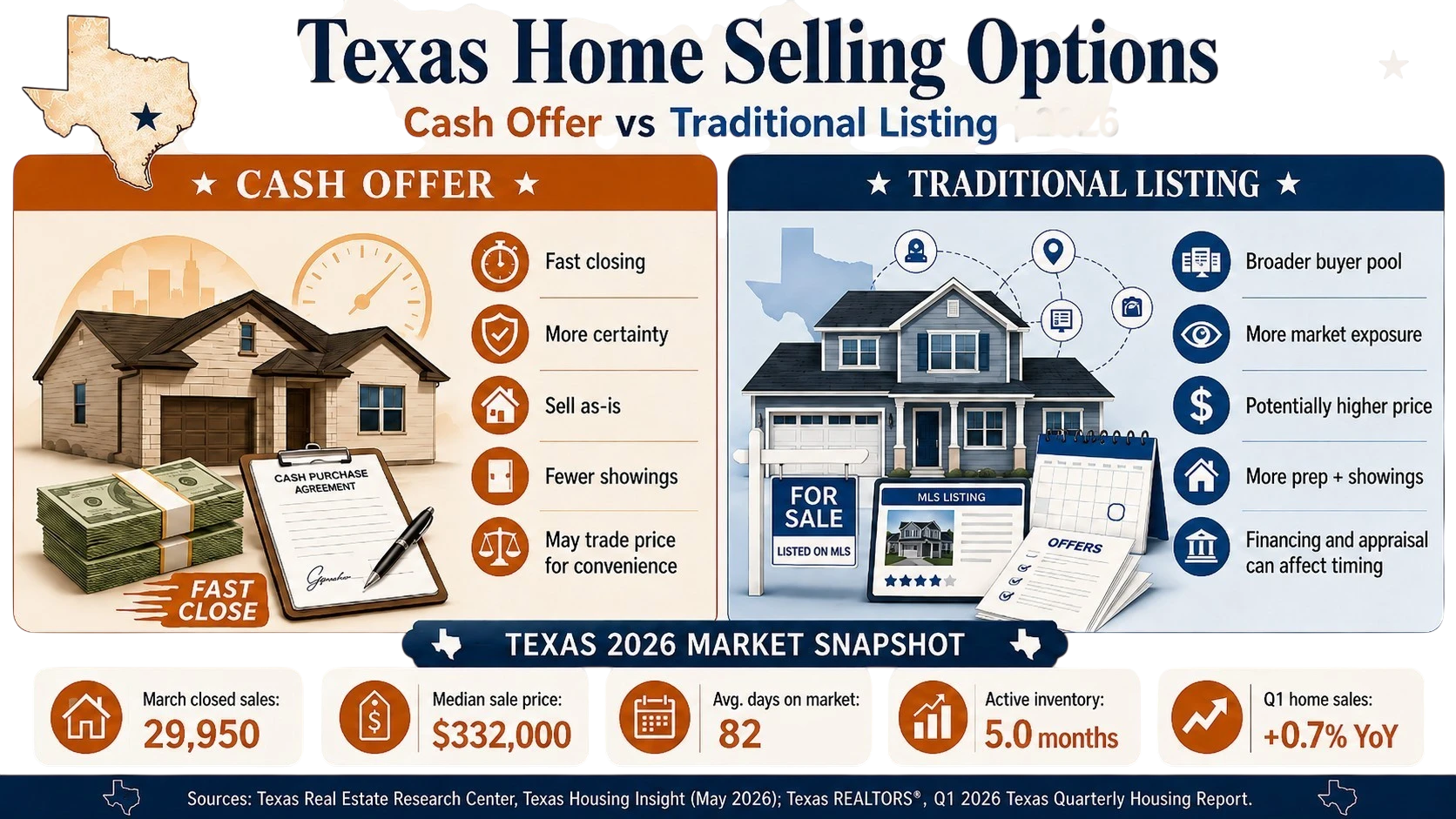
Let’s break down both options.
Texas Housing Market
Before choosing a selling strategy, it helps to understand where the Texas housing market stands right now.
The market has cooled from the fast-moving conditions of the pandemic years. Demand has not disappeared, but buyers are more selective, inventory is higher, and sellers have less room to overprice.
According to the Texas Housing Insight — January 2026, homes in Texas spent an average of 72 days on the market in November. That’s a noticeable slowdown. Even more telling, sellers reduced listing prices by a median of $18,740, roughly a 5% cut, to get deals across the finish line.
Inventory is also shifting. The same report shows turnover dropped to 16.4%, down from over 20% just a couple of years ago. That means homes are sitting longer before selling.
Zooming out, the Texas REALTORS® Q3 2025 report paints a similar picture:
- Median days on market: 52 days
- Average closing time: 34 days
- Total selling timeline: about 86 days
That’s nearly three months from listing to closing.
And pricing?The 2024 Texas Real Estate Year in Review Report shows the statewide median home price reached $330,950, up slightly year-over-year. But growth has slowed, and performance varies by city.
What This Means for Sellers
In today’s Texas market:
- Homes are still selling.
- Buyers have more choices.
- Pricing needs to be realistic from day one.
- Seller concessions and price reductions are more common.
- The right selling strategy depends heavily on timeline, property condition, and financial goals.
That context matters because the fastest option and the highest-price option are not always the same.
Option 1: Sell Fast With a Cash or Guaranteed Offer
For sellers who care most about speed and certainty, a cash buyer or guaranteed-offer program can be appealing.
If you’ve ever wondered how to get a guaranteed offer, the process is usually straightforward. These buyers or companies typically review your home, estimate its value based on local market conditions and property condition, and make an offer. If you accept, the sale can often move much faster than a traditional listing.
In many cases, sellers can skip repairs, showings, open houses, and long negotiations.
Pros of a Fast Cash Sale
A cash or guaranteed-offer style sale can make sense if you want a simpler process.
Key benefits include:
- Speed: You may be able to close much faster than with a traditional listing.
- Convenience: You can often avoid staging, open houses, and repeated showings.
- Certainty: Cash buyers usually do not depend on mortgage approval the same way financed buyers do.
- Flexibility: Some buyers allow you to choose a closing date that works for your schedule.
- Less prep work: Many cash buyers purchase homes as-is.
This route can be especially helpful for sellers dealing with relocation, financial pressure, inherited property, major repairs, divorce, or another situation where waiting several months is not ideal.
Cons of a Fast Cash Sale
The trade-off is usually price.
Cash buyers typically build repair costs, risk, holding costs, and profit margins into their offers. That means the offer may be lower than what the home could potentially bring on the open market.
Possible downsides include:
- Lower offer price: You may not get the highest possible sale price.
- Less competition: Your home is not being exposed to the full buyer pool.
- Limited negotiation: Some offers are flexible, but others are closer to take-it-or-leave-it.
- Program differences: Not all guaranteed-offer programs work the same way, so the details matter.
The bottom line: you are usually trading some upside for speed, convenience, and predictability.
Option 2: List Traditionally With a Real Estate Agent
The traditional route is still the most common way to sell a home.
With this approach, you work with a real estate agent to prepare, price, market, show, negotiate, and close the sale. The goal is to expose your home to as many qualified buyers as possible and create the best chance of receiving a strong offer.
Most sellers still choose this path. According to the National Association of REALTORS®, 91% of recent sellers sold with the help of a real estate agent, while only 5% sold as For Sale By Owner.
That makes sense. Exposure matters, especially when buyers have more homes to choose from.
Pros of a Traditional Listing
A traditional listing can be the better fit if your main goal is maximizing price.
Key benefits include:
- Higher price potential: More exposure can create more buyer interest.
- Professional pricing guidance: A good agent can help you avoid overpricing or underpricing.
- Better marketing reach: Your home can appear on the MLS, major listing sites, agent networks, and digital marketing channels.
- Negotiation support: An agent can help manage offers, inspection requests, appraisal issues, and closing details.
- Structured process: The transaction follows a familiar path with inspections, appraisals, financing deadlines, and paperwork.
Data from the NAR FSBO Sales Analysis shows a notable price gap between FSBO and agent-assisted sales. FSBO homes sold for a median of $360,000, compared with $425,000 for agent-assisted homes. That comparison is not perfectly apples-to-apples because FSBO properties may differ by location, condition, and property type. Still, it shows why many sellers value professional representation.
Cons of a Traditional Listing
A traditional sale can bring more upside, but it also requires more time and effort.
Possible downsides include:
- Longer timeline: In Texas, the full listing-to-closing process can take months.
- Uncertainty: A buyer’s financing, inspection, or appraisal can create delays or cause a deal to fall through.
- Preparation work: Repairs, cleaning, landscaping, photography, and staging may be needed.
- Showings: You may need to keep the home show-ready for weeks.
- Selling costs: Brokerage compensation, closing costs, repairs, and seller concessions can reduce your net proceeds.
Traditional listing can work very well, but it is not always the easiest path. In a slower market, patience matters.
Cash Offer vs. Traditional Listing: The Real Trade-Off
The decision usually comes down to three things: certainty, convenience, and net proceeds.
Certainty
A cash sale usually gives you more certainty because there is less risk tied to buyer financing.
A traditional listing can still close successfully, but there are more moving parts. Financing, inspections, appraisals, and buyer timelines can all affect the deal.
Convenience
A cash sale is usually easier. You may not need to make repairs, host showings, or keep the home spotless while waiting for offers.
A traditional listing takes more effort. You need to prepare the home, allow buyer access, respond to feedback, and stay flexible throughout the process.
Net Proceeds
A cash offer is often lower upfront.
A traditional listing may produce a higher sale price, but the final number depends on the full picture: price reductions, repairs, seller concessions, closing costs, brokerage compensation, and how long the home sits on the market.
That is where the math can get interesting.
If a home sits for months, needs a price cut, requires repairs, and still comes with selling costs, the gap between a fast cash offer and a traditional sale may be smaller than it looked at first.
Not always.
But often enough that sellers should compare real numbers before deciding.
Which Selling Option Fits Your Situation?
There is no one-size-fits-all answer. The right path depends on your timeline, property condition, and priorities.
If You Need to Sell Quickly
A cash or guaranteed-offer style sale may be the better fit if you are dealing with:
- Job relocation
- Divorce
- Financial pressure
- An inherited home
- A vacant property
- A home that needs major repairs
- A tight moving deadline
In this situation, speed and certainty may matter more than getting every possible dollar.
If You Want the Highest Possible Price
A traditional listing may be the better fit if:
- You have time to wait.
- Your home is in good condition.
- You are willing to prepare the property.
- You want full market exposure.
- You are comfortable with showings and negotiations.
This path gives you the best chance to attract multiple buyers and test the open market.
If You Are Buying Another Home
Move-up sellers often face a timing problem. They need to sell their current home, buy the next one, and avoid being stuck between both transactions.
Some sellers choose a cash or guaranteed offer for certainty. Others list traditionally and work with an agent to coordinate contingencies, leasebacks, or flexible closing dates.
The best choice depends on how much timing risk you can handle.
If You Inherited a Property
Inherited homes often come with extra complications. The property may need repairs, multiple heirs may be involved, or the owner may live out of state.
A cash sale can be appealing because it reduces the need for repairs, cleanouts, showings, and months of coordination.
A Simple Decision Framework
Before choosing how to sell your Texas home, ask yourself four questions.
1. How Fast Do I Need to Sell?
If you need to sell in days or weeks, a cash offer may be worth considering.
If you have a few months, a traditional listing may give you more room to pursue a higher price.
2. What Condition Is My Home In?
If the home needs major repairs, a cash buyer may be more appealing.
If the home is clean, updated, and move-in ready, a traditional listing may attract stronger offers.
3. How Much Uncertainty Can I Handle?
If you want a cleaner, more predictable process, a cash sale may fit better.
If you are comfortable with inspections, appraisals, negotiations, and possible delays, listing traditionally may make sense.
4. What Matters More: Time or Money?
Most sellers want both.
But in real life, there is usually a trade-off. The fastest option is not always the most profitable. The highest-price option is not always the easiest or most predictable.
Be honest about what matters most for your situation.
Final Thoughts
Selling a home in Texas today requires a more thoughtful strategy than it did a few years ago.
The market has shifted. Homes are taking longer to sell. Buyers have more choices. Inventory is higher. And pricing matters more than ever.
- If you want speed, simplicity, and predictability, a cash or guaranteed-offer style sale may be the right move.
- If your priority is getting the highest possible price, and you are willing to wait, prepare, and negotiate, listing with an agent can still be a strong option.
Neither path is automatically right or wrong.
It comes down to the trade-off that works for your timeline, your property, and your financial goals.
Take your time. Ask questions. Compare your options. Run the numbers. Then choose the path that gives you the right balance of speed, certainty, and value.