- Figure Out Your Immediate Needs
- The Case for Renting First
- Why Buy Soon After Moving?
- Cost Comparison: Renting versus Buying
- Market Conditions in Your New Location
- How Long Do You Plan to Stay?
- Know Your Credit Score and Financial Status
- Lifestyle and Personal Preferences
- Rent First, Buy Later
- The Bottom Line
Moving to a new city? One of the first things to figure out is whether to rent or buy. It depends on your budget, timeline, and long-term plans, here’s how to weigh your options and make the smartest move for your current situation.
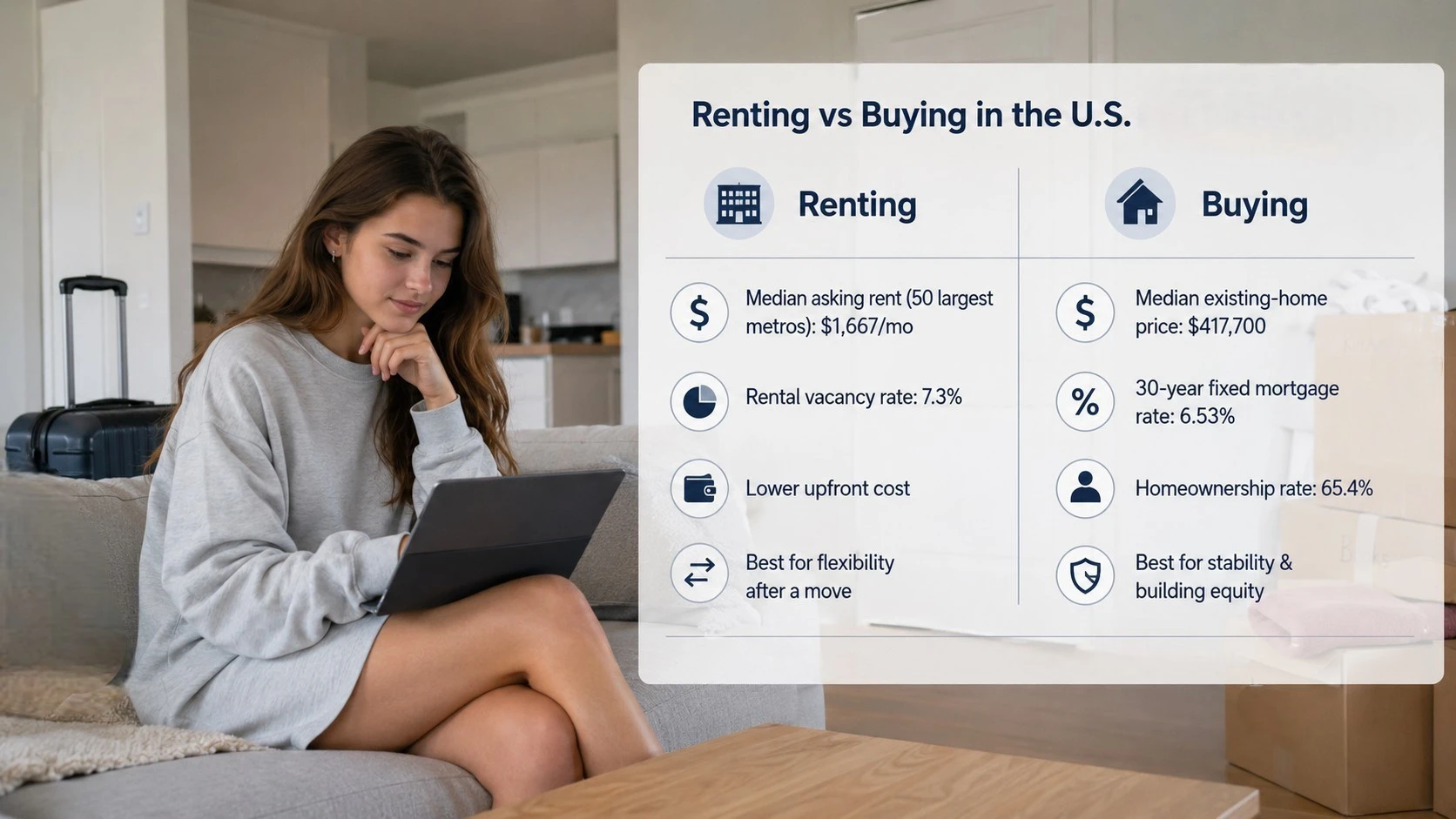
Figure Out Your Immediate Needs
Before you start browsing listings, figure out what you actually need from this move.
- Temporary versus long-term: Are you just trying out a city, or are you putting down roots for several years?
- Job security: Is your role stable, or are you in a probationary period where things could change?
- Family and lifestyle: School districts, commute times, walkability, and access to parks or nightlife can heavily influence your housing choice.
The Case for Renting First
There is a reason many people choose to rent for at least 6 to 12 months after a move. The benefits are hard to beat.
- Flexibility: Renting lets you change neighborhoods or jobs without dealing with a stressful home sale.
- Lower upfront costs: Renters usually face lower upfront costs, such as a security deposit, application fees, and the first month’s rent, while buyers need to plan for a down payment, inspections, appraisals, and closing costs.
- Time to explore: Take the city for a test drive and get a feel for traffic patterns and local hotspots before you buy.
- A clean break: If the city or job doesn’t work out, breaking a lease is usually easier than trying to sell a house in a pinch.
Why Buy Soon After Moving?
If you are 100% sure about your move, buying soon after moving makes sense, if you have stable income, and plan to stay long enough to justify the transaction costs.
- Building equity: Part of each mortgage payment can help build equity over time, though homeowners also need to budget for interest, taxes, insurance, maintenance, and other ownership costs.
- Locked-in stability: With a fixed-rate mortgage, your principal and interest payment stays predictable, though property taxes, homeowners insurance, HOA fees, and maintenance costs can still change.
- Complete control: You can renovate and customize your home without the approval of a property manager.
Cost Comparison: Renting versus Buying
The sticker price is never the whole story. You have to look at the total financial picture.
- Monthly cost: Compare rent and renter’s insurance against a homeowner’s full monthly cost, including principal, interest, property taxes, homeowners insurance, utilities, maintenance, and any HOA fees.
- Upfront payment: Renters pay deposits and application fees, while buyers pay down payments, appraisals, inspections, and closing costs.
- The hidden carrying costs: If the HVAC dies, renters call the landlord. Buyers call a repairman and write a big check.
Market Conditions in Your New Location
Local conditions can tip the scale very quickly.
- Home prices and trends: Is the market cooling off, or are you walking into a bidding war?
- Interest rates: Higher mortgage rates reduce buying power because they make borrowing more expensive, which can lower the price range a buyer can afford.
- Rental supply: A historically tight rental market may push you to buy sooner, while abundant rentals give you time to explore.
How Long Do You Plan to Stay?
Your time horizon is the golden rule of real estate.
- Short-term: Renting often makes more financial sense if you expect to stay only one to three years, because buying and selling costs can outweigh the equity you build.
- Long-term: Owning may become more financially attractive if you plan to stay several years beyond your local break-even point.
- The break-even point: There are online calculators that can help you figure out when buying becomes more economical than renting within your specific zip code.
Know Your Credit Score and Financial Status
Before buying anything, take stock of your financial situation.
- Credit history: Your credit profile can affect whether you qualify for a mortgage and the rate you are offered.
- Debt-to-income ratio: Your existing debts affect exactly how much house you can afford.
- Emergency savings: Buying a home can drain your savings at the same time you need a cushion for repairs, moving costs, and other unexpected expenses.
Lifestyle and Personal Preferences
Your personality is just as important as the math.
- Flexibility versus roots: If you like to move around, renting can be liberating. If you want to put down roots, buying may be more satisfying.
- Maintenance: Are you willing to mow the lawn and fix a leaky sink, or do you want a maintenance-free weekend?
- Community: Some rentals have gyms, pools, and common areas, but with a home, you are more likely to be tied to a stronger, long-term neighborhood community.
Rent First, Buy Later
A common strategy is to rent first, then buy after you know the area better. This lets you test commute times, schools, and neighborhoods in real life. Working with a trusted local moving company can simplify that first relocation so you can focus on scouting where you might eventually purchase.
Tips for Making the Right Decision
- Consult both a real estate professional and a financial advisor.
- Use rent-vs-buy calculators and a detailed budget.
- Visit potential neighborhoods at different times of day and talk to residents.
Common Mistakes to Avoid
- Rushing into a purchase before understanding the local market.
- Underestimating the total cost of ownership, especially maintenance.
- Ignoring long-term career or family plans when choosing a location or property type.
The Bottom Line
Choosing between renting and buying after a relocation comes down to your timeline, your wallet, and the kind of lifestyle you want. There is no universal right answer. Take a breath, run the numbers, and choose the path that makes your move a little less stressful and supports the life you’re building in your new city.