
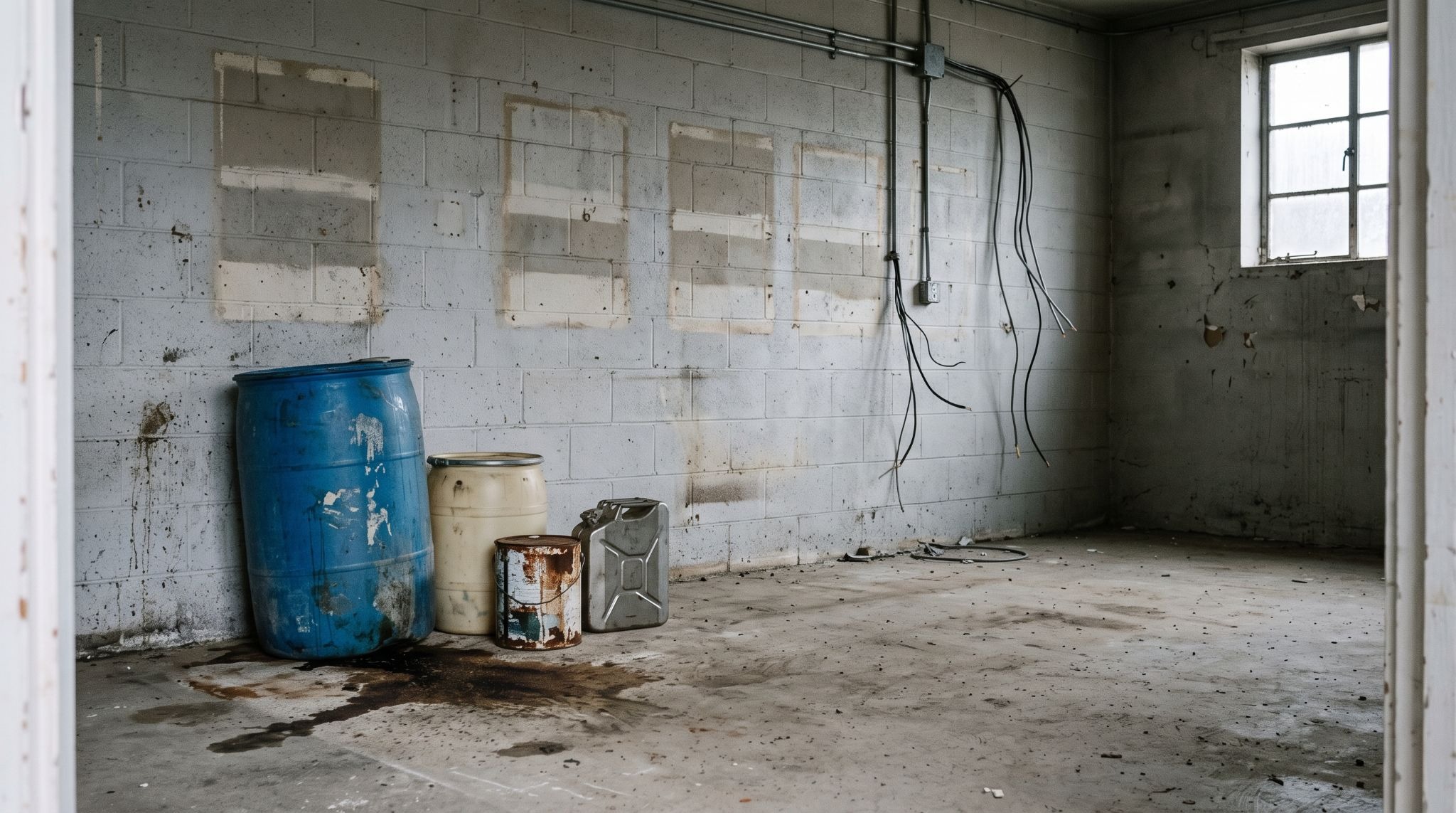
When a tenant hands back the keys, whatever they left behind becomes a problem for the next: a half-drum of solvent in a back room, a shelf of unlabeled bottles behind a salon station. The liability does not leave with the tenant.
Two things decide the risk the chemical poses. How dangerous the substance is, and how easily someone can come into contact with it. An empty building makes the second one worse, because with nobody on site each day, a leaking container can go unnoticed for weeks.
What Tenants Leave Behind
Most chemical risk in a vacated unit comes from ordinary products left in places nobody thought to check. The former use of the space tells you most of what to expect.
| Former use | What usually gets left | Typical hazard |
| Salon or nail bar | Acetone, developer, smoothing treatments | Flammable, irritates the lungs |
| Auto or repair shop | Waste oil, brake cleaner, battery acid | Flammable, corrosive, contaminates soil |
| Dry cleaner | Solvent residue in machines and floor drains | Pollutes groundwater, costly to clean up |
| Warehouse or light industrial | Forklift battery acid, adhesives, unlabeled totes | Corrosive, unknown |
That last row causes the most trouble. Unlabeled means unknown, and nothing moves until the waste is characterized. This is usually field screening by the contractor, lab analysis when screening cannot settle it. That adds both cost and delay.
OSHA’s Hazard Communication Standard requires a safety data sheet for every hazardous chemical in a workplace, and it applies well beyond factories. In fiscal year 2025, OSHA cited hazard communication 2,546 times, second only to fall protection and the fourth straight year it held that spot, according to OSHA’s preliminary figures, presented at the National Safety Council’s Congress & Expo in September 2025.
Property owners often treat the tenant’s chemicals as the tenant’s paperwork. The duty follows the employer whose people are exposed, not the lease. So the moment you send your own maintenance, cleaning, or security staff into that unit, the containers are yours to document
Why the Vacant Stretch Is the Riskiest Phase
The chemical risk goes up during a vacancy because empty units still get visitors, and most of them have no idea what is stored there. Brokers bring prospects through, contractors quote work, inspectors do their rounds.
There is a legal risk on top of the physical one. Under CERCLA, the current owner of a property can be held responsible for contamination they had nothing to do with. The landowner defenses, such as bona fide prospective purchaser, innocent landowner, and contiguous property owner, all start with ‘all appropriate inquiries,’ and since February 13, 2023, the EPA recognizes ASTM E1527-21 as the standard for the Phase I environmental site assessment that satisfies it.
But the inquiry is only the entry ticket. Each defense also carries continuing obligations: reasonable steps to stop ongoing releases, cooperation with responders, compliance with land use restrictions. Drums left behind in a unit you now control sit squarely inside ‘reasonable steps.
A Phase I works from historical records, interviews, and a site walkthrough, and the consultant does note containers and storage areas they can see on the day. What it does not produce is a maintained, container-level inventory tied to current safety data sheets, and a snapshot from the day of the visit is not the same thing as knowing what is in the building next quarter
The same problem appears when a tenant with chemical inventory moves in. A planned laboratory move handles hazardous material controls during planning rather than on moving day.
Abandoned chemicals are a second problem. Once a tenant leaves them behind, the material counts as waste, and the property owner generally pays for disposal. At that stage, the work becomes a specialized remediation job, which costs considerably more than a cleanup.
How to Run a Basic Chemical Risk Assessment in Five Steps
You do not need a safety qualification for a first pass at a chemical risk assessment. You need a phone camera, a notepad, and a record of anything you cannot identify.
- Walk and list. Photograph every container and record its location, whatever the label says, roughly how full it is, and the condition it is in. A 250 ml bottle of drain opener is still corrosive.
- Identify what you have. Look up a safety data sheet for each labeled product using the product name and manufacturer. Sections 2, 4, 7, and 8 give you the hazards, first aid, storage rules, and protective equipment. If a container has no label, do not open it. Log it as unknown and set it aside for a licensed contractor.
- Work out who gets exposed. For each chemical, write down who comes near it, how often, and for how long. A drum in a locked room that a cleaner enters once a month scores much lower than the same drum beside a stairwell.
- Score and rank. Rate severity from 1 to 5 and likelihood from 1 to 5, then multiply. Anything scoring 15 or above gets dealt with this week.
- Assign a control and a deadline. Removal, containment, locked storage, signage, ventilation. Write a name and a date beside every one.
Paper works fine for one small unit. It stops working across a portfolio because the hazard information comes from safety data sheets, and manufacturers change their formulas. A chemical risk assessment software keeps steps two through five tied to the current sheet, so last year’s score still matches what is in the container.
The Paperwork That Protects You Later
Keep five things on file for every unit you have assessed for chemical risk:
- The dated container inventory behind the chemical risk assessment, with photographs attached.
- The completed chemical risk assessment showing what you found, how you scored it, and what you did about it.
- Safety data sheets for everything you identified, kept as long as the product stays on site. Note that purging the sheet does not end the obligation: OSHA’s records rule still expects a record of the chemical’s identity, where it was used, and when, for thirty years.
- Waste manifests. They are your proof that regulated material went out through a licensed contractor rather than a dumpster.
- A signed handover note recording exactly what the outgoing tenant left, agreed by both sides. It takes ten minutes at move-out and settles arguments that otherwise run for months.
Making Chemical Risk Part of Every Turnover
Add a chemical risk walkthrough to your standard turnover checklist, alongside the electrical check and the roof inspection. It costs far less than handling the problem after a contractor reports a smell.
What the walkthrough finds then has to stay on record. Past a handful of properties, that means one chemical inventory covering all of them, updated at every move-in and move-out. At that scale, it is a chemical inventory management job, not a spreadsheet.
Start with your longest vacant unit. Walk it this week, photograph every container, and score what you find. If you cannot identify something, call a licensed hazardous waste contractor rather than investigating yourself.