- What Is Precision Metalwork in Modern Home Design?
- How Is Precision Metalwork Changing Modern Home Design?
- What Are the Main Applications of Precision Metalwork in Modern Homes?
- What Materials and Fabrication Processes Are Used?
- Precision Fabrication Processes Used for Residential Metalwork
- What Are the Advantages of Precision Metalwork in Home Design?
- What Are the Limitations of Using Precision Metalwork?
- How to Choose Precision Metalwork for a Home Project
- How Much Does Custom Metalwork for a Home Cost?
- Conclusion
Precision metalwork is the accurate cutting, bending, joining, and finishing of metal components for architectural and decorative use. Once linked mainly with factories and heavy construction, it now shapes refined details inside contemporary homes. Slim steel doors, floating staircases, perforated screens, folded kitchen surfaces, and sculptural lighting all depend on controlled fabrication.
Modern residential design asks materials to do more with less visual weight. Homeowners want open rooms, larger glazed areas, durable surfaces, and features designed for a specific space. This guide explains how precision metalwork supports those goals, where it is used, which materials and processes fabricators use, the benefits and limitations it offers, and how buyers can plan a successful project.
What Is Precision Metalwork in Modern Home Design?
Precision metalwork is a form of metal fabrication that produces parts according to exact dimensions, angles, tolerances, and finish requirements. A fabricator begins with drawings or a digital model, chooses a suitable alloy, cuts the material, forms it, joins separate pieces, and checks the finished component against the design.
The word precision is important. A railing may need evenly spaced balusters, a steel door must align with glazing and seals, and a staircase must meet structural and safety requirements. Small errors can become visible once metal meets glass, timber, stone, or plaster. Modern fabrication reduces those inconsistencies through repeatable machine movements and quality checks. The result is metalwork that fits accurately and performs as part of the building.
How Is Precision Metalwork Changing Modern Home Design?
Precision metalwork is changing modern homes by making architectural elements slimmer, stronger, and more customizable. Accurate fabrication allows designers to use narrow window frames, hide fixings, repeat geometric patterns, and create parts for difficult corners or unusual ceiling heights.
It also gives practical elements a stronger visual role. A staircase can become the center of an entrance hall, while a perforated screen can divide an open-plan room without blocking light. Folded metal can create a continuous kitchen hood, shelf, or fireplace surround with fewer visible joints.
Processes such as laser cutting technology and press brake bending turn digital designs into parts with controlled edges and angles. This connection between design software and fabrication equipment supports forms that would be slow or inconsistent to make by hand.
What Are the Main Applications of Precision Metalwork in Modern Homes?
Precision metalwork has architectural, functional, protective, and decorative applications throughout a home. Some parts carry loads or prevent falls, while others control light, define space, conceal services, or establish a visual theme. The same feature may do several jobs at once. For example, a metal screen can provide privacy, support climbing plants, cast patterned shadows, and become a focal point.
The most successful applications are designed around the building rather than added after construction. Dimensions, connection points, surrounding materials, drainage, movement, and installation access all influence the final result. The following two groups show where custom metalwork most often appears.
Architectural and Exterior Metalwork Applications
Architectural and exterior metalwork includes components that shape circulation, security, weather protection, and a home’s exterior appearance. These parts must fit accurately because they often connect with structural framing, masonry, glazing, roofing, or landscaping. Exterior pieces also need suitable alloys, coatings, drainage details, and fixings to resist moisture and temperature changes.
Six common architectural and exterior applications are:
- Window and door frames: Slim steel or aluminum profiles support broad glazed areas.
- Staircases: Fabricated stringers and supports create straight, folded, or floating forms.
- Railings and balustrades: Accurate spacing combines safety with clean visual lines.
- Facade panels: Folded or perforated sheets add texture, shade, and weather protection.
- Gates and fencing: Digital cutting enables secure panels with custom patterns.
- Pergolas and canopies: Formed sections create durable outdoor structures with minimal profiles.
Interior and Decorative Metalwork Applications
Interior metalwork turns everyday fittings into coordinated design elements. Because indoor components are viewed closely, edge quality, joint alignment, surface texture, and color consistency matter as much as strength. Designers often repeat one finish, such as brushed brass or black powder-coated steel, across handles, shelves, screens, lighting, and furniture to connect separate rooms.
Six common interior applications are:
- Room dividers and screens: Cut patterns separate zones without blocking all light.
- Kitchen features: Metal forms hoods, shelves, cabinet fronts, islands, and backsplashes.
- Furniture frames: Thin sections support tables, benches, shelving, and storage units.
- Fireplace surrounds: Fabricated panels create durable, heat-resistant focal points.
- Lighting fixtures: Cut-and-formed sheets produce pendants and sculptural wall lights.
- Decorative wall panels: Patterned metal adds depth, reflection, and artwork-like detail.
What Materials and Fabrication Processes Are Used?
Architectural metals are materials chosen for strength, weight, corrosion resistance, workability, finish, and appearance. Precision fabrication processes are controlled methods that cut, shape, join, and protect those materials. Designers select both together because a form made in aluminum may need different thicknesses, tools, and supports when produced in steel or copper.
A project may pass through several stages. CNC laser cutting creates the outline, bending forms angles, welding joins sections, and grinding prepares the surface for polishing or powder coating. The correct combination depends on whether the component is structural or decorative, indoors or outside, and unique or repeated.
Common Metals Used in Modern Home Design
Architectural metals are metals used to provide structure, protection, function, or decoration within a building. Each type behaves differently when exposed to loads, moisture, heat, cleaning chemicals, and outdoor weather. Color and aging also matter because some homeowners want a stable finish, while others prefer a surface that develops character over time.
The six choices are:
- Carbon steel: Strong and versatile for stairs, frames, railings, and furniture.
- Stainless steel: Corrosion-resistant for kitchens, bathrooms, and exposed locations.
- Aluminum: Lightweight and naturally corrosion-resistant for frames, screens, and panels.
- Brass: Warm-toned and suited to trims, handles, lighting, and detailed accents.
- Copper: Distinctive and capable of developing a natural patina on roofs or features.
- Weathering steel: Forms a controlled rust-like surface in carefully detailed outdoor work.
Precision Fabrication Processes Used for Residential Metalwork
Precision metal fabrication is the collection of processes used to turn metal stock into components that match a technical design. The chosen sequence affects accuracy, strength, seams, finish, speed, cost, and repeatability.
The main processes are:
- CNC laser cutting: Produces accurate outlines, openings, and patterns.
- Press brake forming: Creates controlled folds and angled profiles.
- Welding: Joins parts into frames, stairs, and assemblies.
- CNC machining: Produces detailed connections and precision parts.
- Rolling: Forms curves and rounded sections.
- Perforating: Creates repeated openings for screening or ventilation.
- Powder coating: adds a durable, colored finish.
- Brushing and polishing: Create decorative surface textures.
Fiber laser cutting machines are common for sheet metal because they combine high speed with high laser cutting accuracy. Other types of laser cutting machines suit different laser cutting materials and thicknesses.
How Does Press Brake Bending Create Accurate Architectural Features?
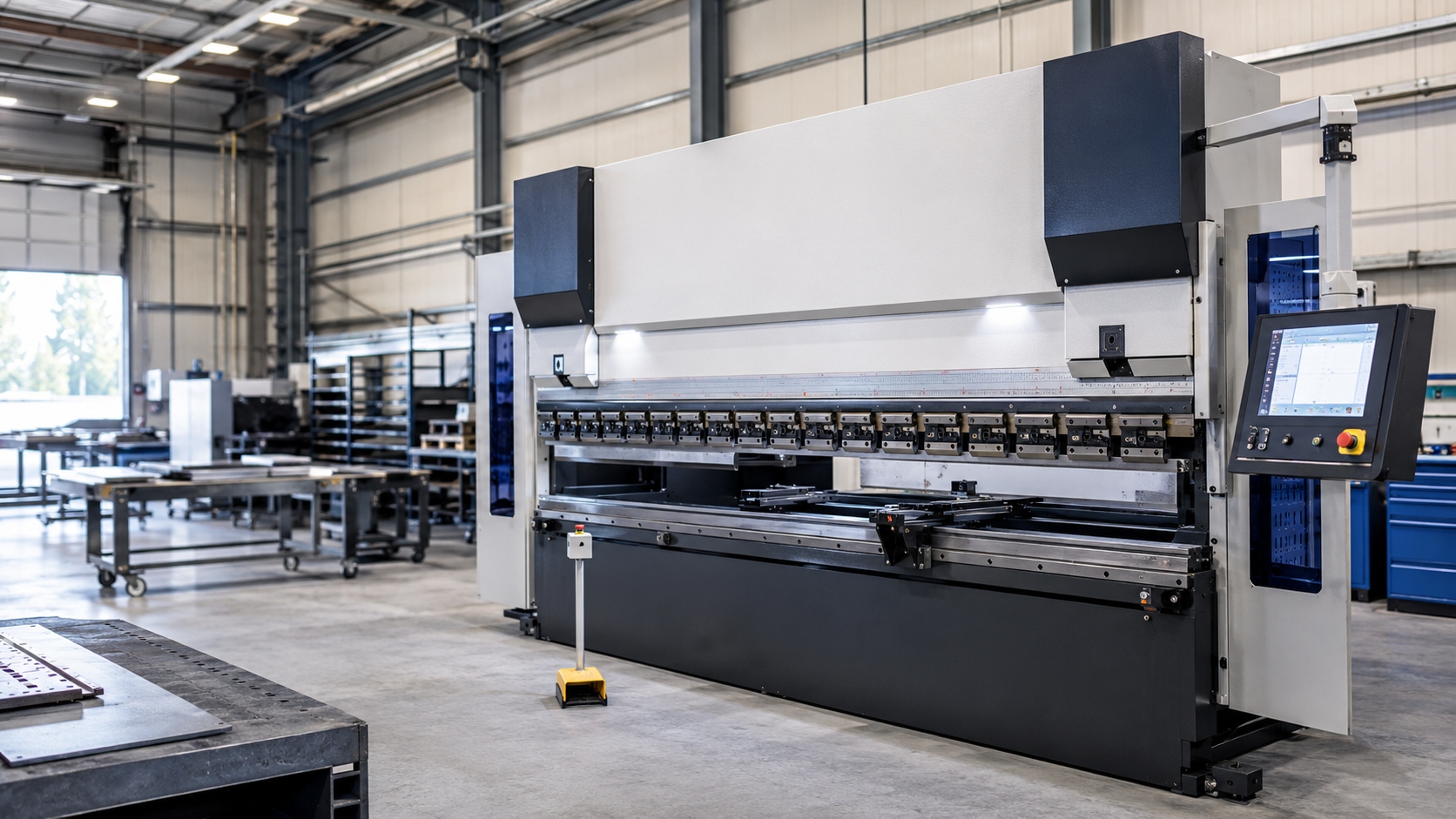
Press brake bending is a forming process in which a machine presses sheet metal between a punch and die to create a measured fold. The operator sets the location, tooling, force, and target angle for the alloy, thickness, and geometry. Fabricators also compensate for springback after pressure is released.
Press brake machines create stair parts, door frames, flashings, countertops, facade panels, shelves, and fireplace surrounds. CNC press brake machines control the ram and back gauge for repeatable work, while hydraulic press brake machines provide high forming force. A servo press offers responsive motion, tandem press brakes handle long pieces, and robotic press brakes automate repeated bends. Accurate results also require suitable tooling, properly maintained press brake parts and components, and the avoidance of press brake mistakes, such as incorrect bend allowances.
What Are the Advantages of Precision Metalwork in Home Design?
Precision metalwork offers accuracy, strength, customization, consistency, and compatibility with other building materials. It can transform a practical requirement into a distinctive architectural feature while keeping profiles relatively slim. Digital layouts and repeatable production also help multiple panels, balusters, or brackets match one another throughout a project.
Seven major advantages are:
- Improve design accuracy: Produce components that follow detailed drawings and measured spaces.
- Increase structural strength: Support slim frames and open forms with durable material.
- Enable customization: Adapt dimensions, patterns, colors, textures, and connection details.
- Create cleaner finishes: Reduce uneven edges, visible fixings, and irregular joints.
- Improve consistency: Repeat matching shapes across railings, panels, and decorative systems.
- Combine materials effectively: Align metal precisely with glass, stone, timber, and concrete.
- Reduce waste: Use digital nesting and controlled cuts to improve material utilization.
Environmental performance still depends on responsible sourcing, fabrication efficiency, coating choice, lifespan, repairability, and recycling.
What Are the Limitations of Using Precision Metalwork?
Precision metalwork can cost more initially, demand accurate planning, and require specialist installation. Custom components are less forgiving than standard products because they are made for particular dimensions and connection points. A measurement error or a late design change can affect several linked parts.
Five important limitations are:
- Increase initial costs by adding engineering, programming, tooling, finishing, and installation expenses.
- Require early decisions: Make late changes more difficult once fabrication has started.
- Create corrosion risks: Allow deterioration when unsuitable metals or coatings are exposed to moisture.
- Add weight: Require stronger supports and careful handling for large steel assemblies.
- Limit site adjustment: Make highly finished parts difficult to cut or alter without damage.
These risks can be reduced through coordinated drawings, verified site measurements, suitable finishes, mock-ups, and clear assignment of responsibility among the designer, engineer, fabricator, and installer.
How to Choose Precision Metalwork for a Home Project
Choosing custom metalwork involves defining its purpose, confirming technical requirements, selecting a material, matching the design to suitable processes, reviewing samples, and planning installation. The decision must balance appearance with load, safety, moisture, access, and maintenance.
Use these six steps:
- Define the purpose: Decide whether the feature is structural, protective, functional, decorative, or mixed.
- Confirm measurements: Verify dimensions, loads, spacing, access, and building rules.
- Choose the metal: Compare strength, weight, corrosion resistance, finish, and upkeep.
- Select the process: Match the design with cutting, forming, welding, machining, and coating.
- Approve drawings and samples: Review joints, edges, colors, textures, and fixings.
- Plan installation: Check lifting needs, doorway clearance, sequencing, and site protection.
For complex or overseas sourcing, a supplier capability assessment can show whether a workshop has the equipment, skills, capacity, and quality systems required. This supplier evaluation is more useful than choosing solely based on the lowest quotation.
How Much Does Custom Metalwork for a Home Cost?
Custom metalwork prices vary with material, dimensions, finish, labor, engineering, access, and local rates. In the United States, railings may cost $150 to $900 per linear foot, decorative panels $50 to $300 per square foot, and room dividers $1,500 to $10,000 or more. A custom metal staircase may cost $10,000 to $50,000 or more, including engineering and installation.
Six factors affect the final price:
- Metal type: Stainless steel, brass, and copper often cost more than carbon steel.
- Material thickness: Heavier sections increase material and handling costs.
- Design complexity: Curves, patterns, and concealed joints require more work.
- Fabrication processes: Cutting, machining, rolling, and welding add production time.
- Surface finish: Polishing, patina, plating, or coating changes the cost.
- Delivery and installation: Large assemblies may need special transport and lifting.
Conclusion
Precision metalwork is changing modern home design by joining engineering disciplines with architectural creativity. It allows homes to use slimmer frames, larger glazed areas, cleaner junctions, custom patterns, and practical features that also serve as visual statements. Metal can define a staircase, divide a room, protect an exterior, support furniture, or bring warmth and texture to a quiet interior.
Strong results depend on more than an attractive concept. Material properties, fabrication accuracy, corrosion protection, structural loads, installation access, and future maintenance must be considered together. Early collaboration between the homeowner, designer, engineer, fabricator, and installer gives each component the best chance of fitting correctly and aging well. When those decisions are coordinated, precision metalwork becomes part of the architecture itself.