Cash home buyers in major cities have it relatively easy. There’s a constant flow of comparable sales, a deep bench of contractors, and enough buyer demand that almost any flipped or rented property will move. But once you step outside those metros and look at local Alabama markets, the math changes in ways that catch a lot of investors off guard.
Cities like Tuscaloosa aren’t sleepy markets, but they aren’t Dallas, either. Buying distressed property here requires a different evaluation process. The cash buyers who make money consistently in these areas have learned to adjust their approach.
Here’s what actually happens when an experienced buyer pulls up to a tired single-family home.
Finding the Right After-Repair Value (ARV)
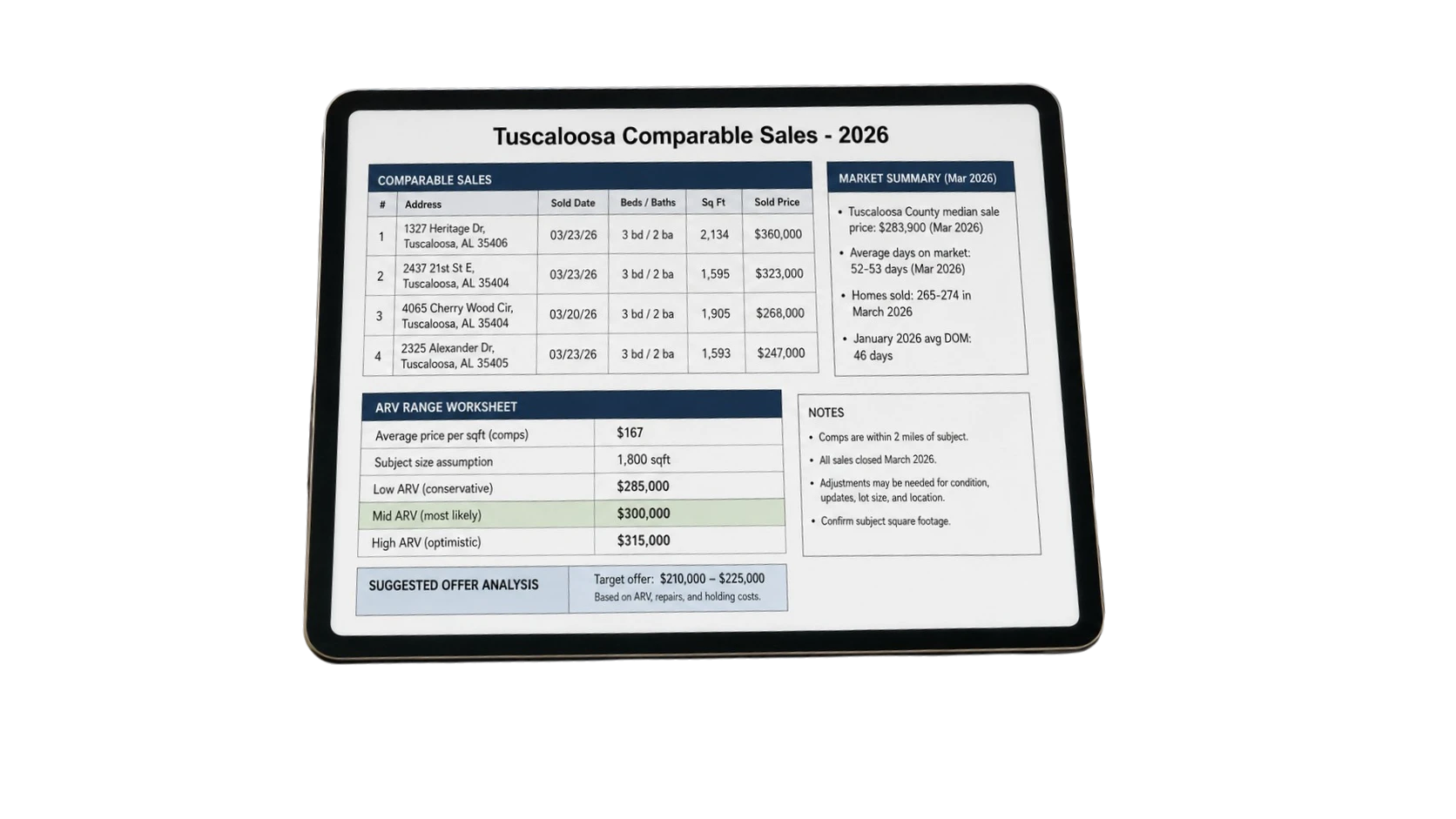
you can pull six or eight closed sales within half a mile that perfectly match the subject property’s bed count, bath count, square footage, and condition. In a local market, you might find two—and one of them likely sold to a relative for $40,000 under market value.
This is the first place inexperienced buyers go wrong. They treat thin comp sets the same way they treat a stack of clean Atlanta data, leading to an after-repair value that is wishful thinking at best.
Seasoned cash buyers learn to expand their search radius carefully. They weigh comps by recency rather than just proximity and discount sales that look like outliers. They also pay close attention to days on market (DOM) for renovated properties. A flipped house in Tuscaloosa or Northport that sat for 110 days tells a very different story than the exact same house selling in 18 days.
The buyers who consistently profit in these markets use a range rather than a point estimate. Instead of insisting a house will sell for $185,000 after repairs, they set a realistic range of $170,000 to $195,000, and build their offer off the bottom of that range. That cushion is what keeps them from getting burned when a deal goes sideways.
Estimating Repairs with Local Alabama Contractors
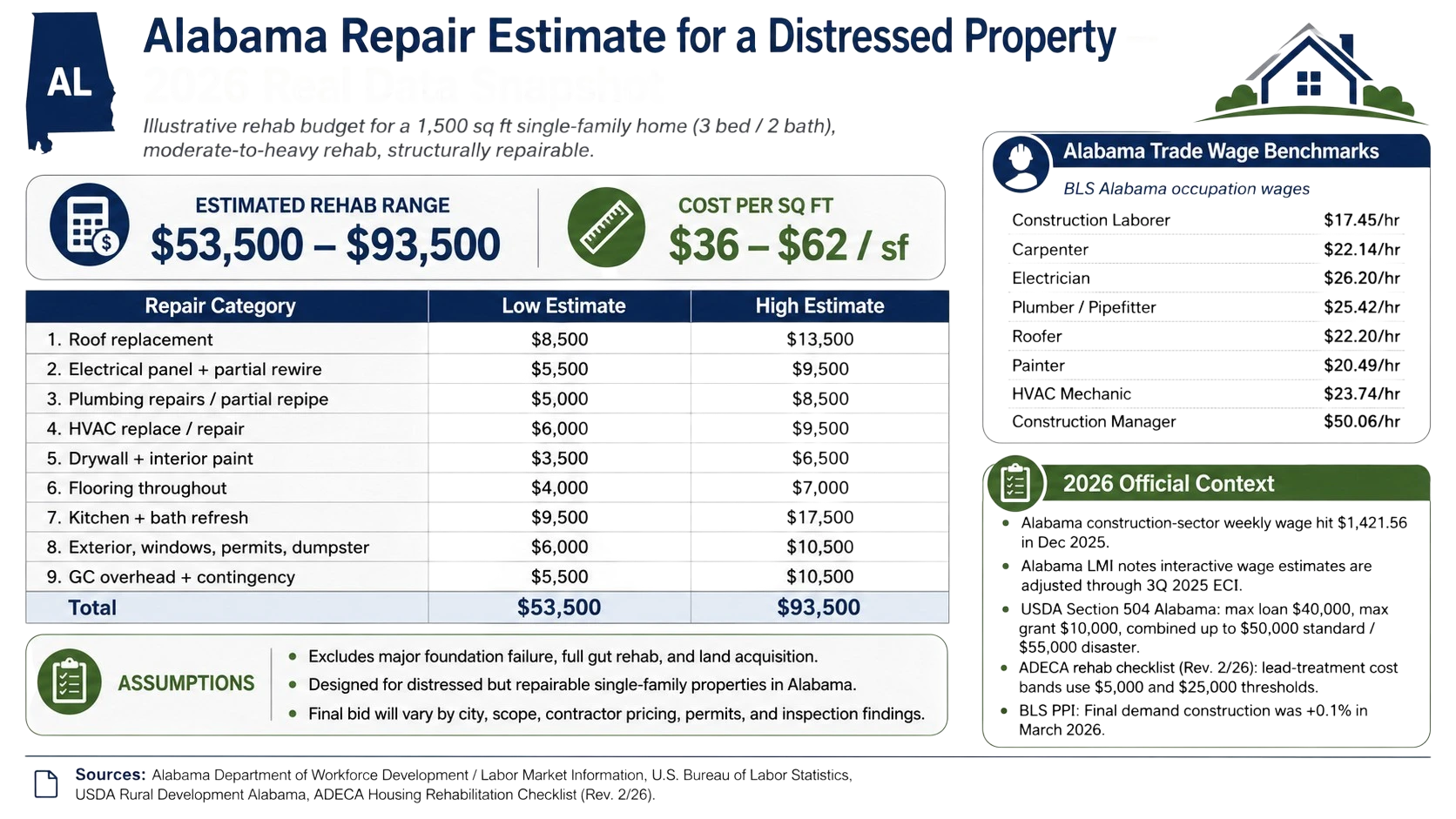
In a city like Houston or Dallas, an investor can call 50 different contractors and get a roof bid by tomorrow. In Tuscaloosa, you might know three reliable general contractors, and two of them are booked for the next four months.
That limited labor pool affects two big things:
- Costs: Repair costs in local markets aren’t always cheaper than in major metros. Material prices are roughly the same everywhere, and labor in tight Alabama markets can actually run higher because there isn’t as much competition.
- Timelines: Project schedules stretch out. A renovation that takes six weeks in Birmingham might take 14 in a surrounding neighborhood because subcontractors only show up on Tuesdays and Thursdays.
Smart cash buyers build padding into both of these numbers. They estimate repairs on the high side, add a 15% to 20% contingency for surprises, and factor extra months of holding costs into their underwriting. A cheap-looking deal that pencils at $25,000 in repairs and a two-month hold often morphs into a $38,000 project and a five-month hold, until the spread is gone.
Experienced buyers also walk the property differently. They don’t just check for visible cosmetic issues. They crawl under the house, inspect the electrical panel, look for signs of water intrusion in the attic, and test whether the HVAC actually cycles.
How Local Demand Patterns Drive the Offer
A distressed property in a major metro almost always has an exit strategy. Worst case, you wholesale it. Second worst, you rent it. The market is deep enough that something will work.
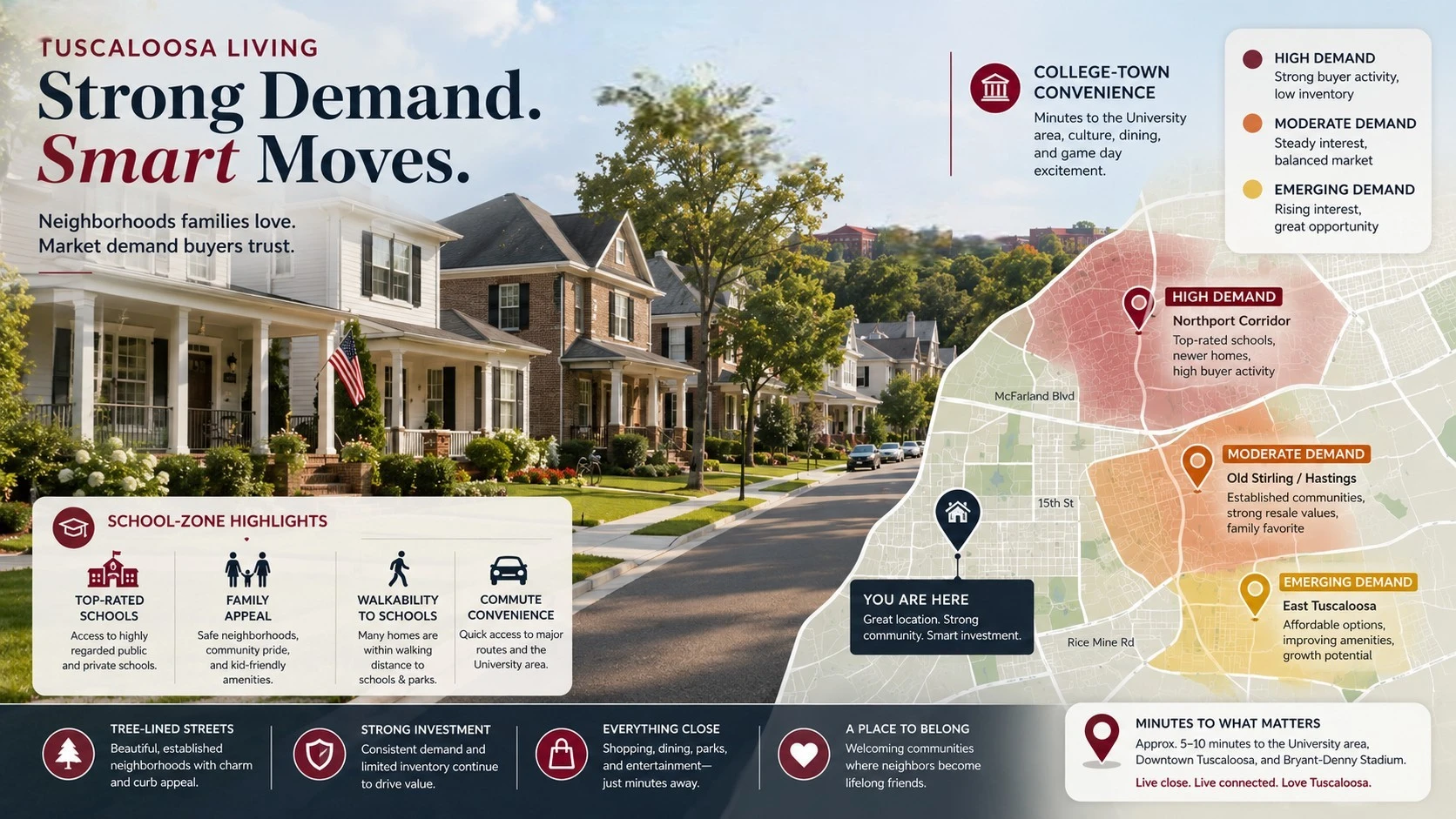
Outside major metros, exit strategies are narrower and heavily dependent on micro-conditions. A three-bedroom ranch in the college town of Tuscaloosa has a very different buyer pool than the same house 30 miles away in a county seat with a declining population.
Companies like the cash home buyers in Tuscaloosa who actually live and work in these markets understand which neighborhoods are appreciating because of university expansion, which subdivisions appeal to young families relocating for jobs, and which streets have buyer demand that simply doesn’t exist two blocks over.
That kind of local pattern recognition is hard to replicate from a spreadsheet. It’s exactly why out-of-state investors attempting to buy remotely in Alabama often underperform compared to local buyers, who know that a single elementary school redistricting decision can swing property values 15% on a specific street.
When evaluating a distressed property, smart buyers ask: Who is the realistic end buyer, and how many of them exist in this specific submarket right now? If the target is an FHA buyer between $180,000 and $220,000 with decent credit, investors need to know if that buyer pool is shrinking or growing. If it’s shrinking, the offer comes down, regardless of what the comps say.
Pricing in Local Market Risks
The biggest difference between metro and non-metro evaluations comes down to how cash buyers handle risk. In a deep market, if your renovation runs long or the buyer pool softens, you drop the price by 2% and the property still sells. In a local market, those same conditions can mean the property sits untouched for six months.
Experienced buyers price this risk upfront. They run their numbers with a bigger downside case, model what happens if they are forced to rent the property for a year, and only move forward if the deal still works under those stressed assumptions. As a result, their offers are often a lower percentage of the asking value than what a comparable metro buyer might offer. This isn’t out of greed; it’s because the downside scenarios are genuinely more painful.
Insurance and tax situations carry more weight here, too. A fire-damaged home in Tuscaloosa County might face higher future insurance costs or be hard to insure at all. A property in a flood-prone neighborhood near the Black Warrior River might require flood insurance that cuts into rental returns. These aren’t necessarily deal-killers, but they must be priced into the initial offer rather than discovered after closing.
Selling Your Tuscaloosa Home for Cash
Cash buyers who consistently win outside major metros aren’t smarter than their big-city counterparts, they are just more disciplined about acknowledging what they don’t know and pricing accordingly. They rely on conservative ARV ranges, padded repair estimates, realistic timelines, and risk-adjusted offers that reflect the realities of narrower exit options.
For homeowners selling distressed property in Tuscaloosa, that matters. The cash offer you receive isn’t arbitrary. It comes from a specific calculation around comps, repairs, holding costs, and the real difficulty of moving the property after the work is done. Understanding that math helps you evaluate whether a specific offer is fair, a lowball, or actually pretty reasonable given the risks the buyer is taking on.