
Allen Gwinn is a number cruncher. Or a gadfly. Or a muckraker/local political analyst. By day, he teaches at SMU School of Business as a Professor of Practice.
Basically a detailed data miner, he has taught information technology at SMU Cox School of Business for 30 years. For years, Gwinn also ran a popular website called Dallas.org, which was 18,000 registered users rich, as large as many local media sites. As he puts it, “I had lots of bandwidth.”
Now Gwinn is gearing up a reboot of Dallas.org, because he believes that taxpayers need a constant stream of data about government spending. An informed citizenry, he feels, makes better voting decisions, which is why he analyzes public data.
“I’m putting together a bunch of data to analyze revenue and expenses at DISD,” he said by phone. “We can show exactly what tax dollars they are getting. It’s eye-opening. DISD historically has been very, very closed with the very data taxpayers need.” But before we dug into school taxes, I flipped out over his tracking of who pays property taxes. I hope a fainting couch is nearby:
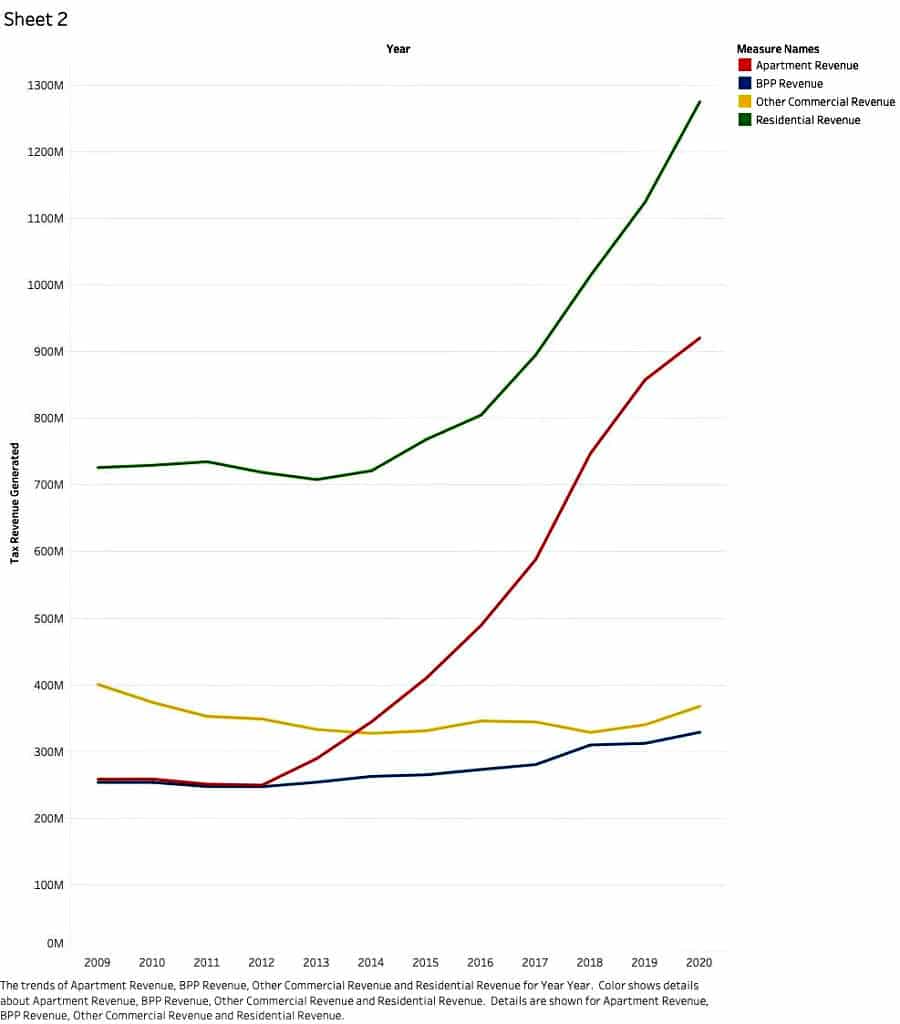
“Keep in mind that tax revenues levied on Dallas residents and renters have (not quite) doubled since 2013.”
Gwinn’s chart, above, caught my eye on the Reform Dallas Facebook page and I asked for permission to post it. Dallas City Council is back from July vacation and currently looking over next year’s budget, which includes a “small” property tax hike.
(BPP is business personal property and includes things like office machines, computers and other fixtures and furnishings used for business purposes.)
Last Friday, City Manager T.C. Broadnax unveiled his proposed budget with a property tax rate of 78 cents for each $100 of valuation — one-third of a cent higher — to, he said, address the city’s police officer shortfall (because everyone is bemoaning our short-staffed DPD). Broadnax is also bracing (and probably squirreling away dollars) for the upcoming state tax restrictions. His proposed tax raise would add $4.5 million to the city’s coffers with a cost to the taxpayers of $8 to $10 a year for a $300,000 home. The average home price in Dallas is about $277,000.
The interesting thing about Gwinn’s chart is that it shows, almost breathtakingly, how much homeowners shoulder the burden of taxes in North Texas. But look — apartment renters are catching up with us. And of course, landlords are passing those onto renters. Here is more:
“I was analyzing ad-valorem tax revenue, for DISD and the City of Dallas combined, and some of it is turning out to be pretty interesting,” said Gwinn. “For instance, I was surprised to see how quickly tax revenue from apartments (red) was rising. Obviously, homeowners get stuck with the bulk of the tax burden (green) but apartment tax revenue is really closing the gap. The yellow line represents revenue from other commercial buildings (excluding apartments) and the blue line is revenue from BPP. I can show you how little the commercial side chips into ad valorem taxes.”
No kidding. Tax revenue from commercial properties is not only flat as a pancake, it actually dipped in 2012 while homeowner’s paid even more taxes as the values of their homes rose dramatically post the 2010 recession. That’s why Gwinn is revving up Dallas.org. Eventually, he will even have a page for renters to choose their apartment complex, enter the square footage, and find exactly what the landlord (and subsequently tenant), pays in property taxes — very cool. Here is what the Lakewood Advocate reported more than 10 years ago:
No Dallas citizen or official is beyond scrutiny, and Gwinn doesn’t mind naming names. But Gwinn’s whistle sounds most vehemently for Dallas ISD education reform. The reason, he says, is simple: “Money and kids. You may think public education is free, but more than 50 percent of your taxes go to DISD. If your child goes to private school or you don’t have kids, you are still paying for public education. It never ceases to amaze me that there aren’t 50,000 people like me watching [DISD] under a microscope.”
And he is still focusing the microscope. Gwinn doesn’t believe the City of Dallas or Dallas ISD consciously try to do evil: as big bloated bureaucracies, they just make a lot of mistakes, he says. Actually, the city of Dallas is pretty transparent when it comes to open data, he says. Not so Dallas ISD.
“DISD tries to do everything they can to keep everything under wraps,” he says. “They don’t even want the trustees to look at the data.”
And apartment renters, he says, need to know that they are not immune from rising property taxes.
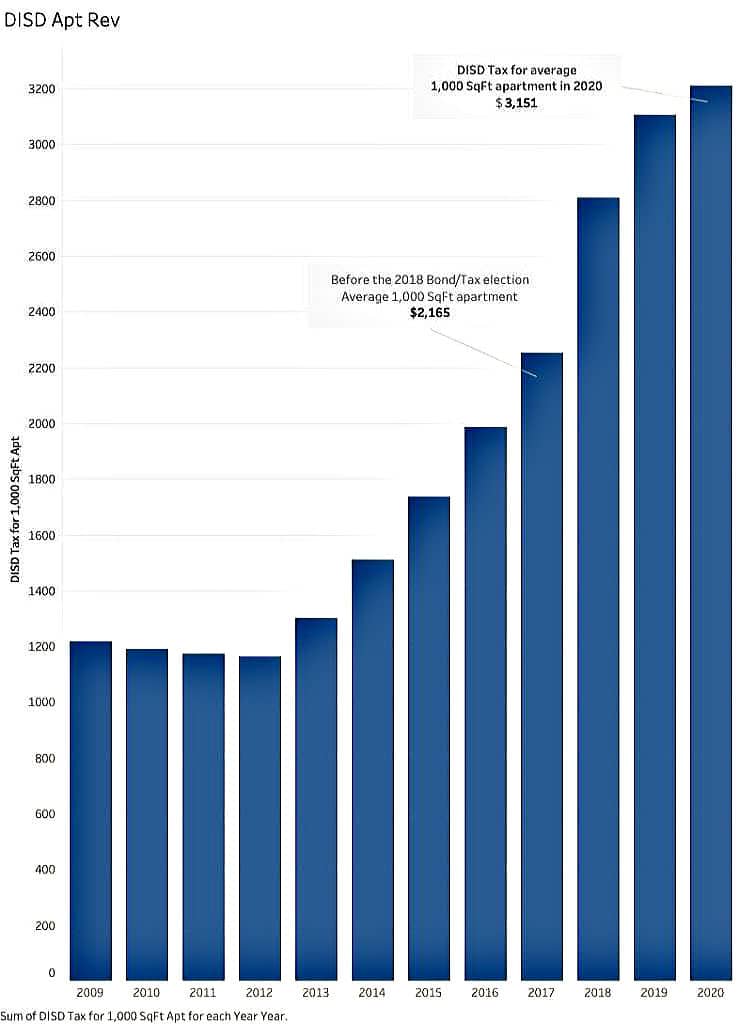
“As to the 2018 DISD bond election and tax increase, homeowners weren’t the only ones impacted,” says Gwinn. “Renters were too. The DISD tax on an average 1,000 square foot apartment will go from $2,165/year to $3,151/year by the time your landlord pays his 2020 taxes. Obviously, some will pay more, some will pay less. But just because you live in an apartment doesn’t mean you’re immune from ad valorem property taxes. You also have to wonder what effect these increases are having on the gentrification of Dallas.”
We’ll be hearing more from Gwinn — like he says, you gotta get people informed, get them involved.
“You can’t just fish more money out of people’s pockets,” he said. “Keep in mind that tax revenues levied on Dallas residents and renters have (not quite) doubled since 2013.”