The city of Dallas is operating at a razor-thin margin, and cannot afford to waste its opportunities. Infrastructure alone will cost $900 million dollars to just bring our streets up to a satisfactory level. Meanwhile, the city is still responsible for public safety, code compliance, parks and recreation, among many other services that require money to operate. In order to address this deficit, we often talk about raising taxes or cutting services, but what we don’t often consider more efficient and productive land use.
According to the 2016 City Budget, property tax currently contributes to almost 50 percent of revenue to the general fund. In the same document, about 8 percent of the general fund ($90 million) has been allocated to the streets department, and about half of that is dedicated to maintenance and repair. If the city continues to operate this way, it will take 20 years to repair our streets to a satisfactory level according to 2015 standards and finances. At the same time, police response times are embarrassingly abysmal as streets continue to deteriorate.
The Productive Land Use Series will focus on annual property tax revenue at the neighborhood level. Since land is the city’s primary resource, this series will delve into how we are using our land and if we can use it more efficiently. The base unit of measurement will be the acre in order to measure the productivity of a community. Using publicly available data, we will take a look at specific structures in different neighborhoods and various developments in Dallas through the lens of Google Earth and the Dallas County Appraisal District. More data is available, but for this post, I’ve chosen to take a look at the acreage, the estimated taxes paid (via dcad.org), city taxes collected per acre, total taxes collected per acre, and the age of the building.
In this series, we will take a hard look at empirical data behind our City’s finances. For this study, I will suspend politics and culture in an effort to present data in its rawest form. Admittedly, analyzing the numbers is the equivalent of eating your vegetables in a meat-heavy diet. Still, in order to strategize for the long term prosperity of Dallas, we have to understand how a city builds wealth.
To start, let’s take a look at typical single family dwellings.
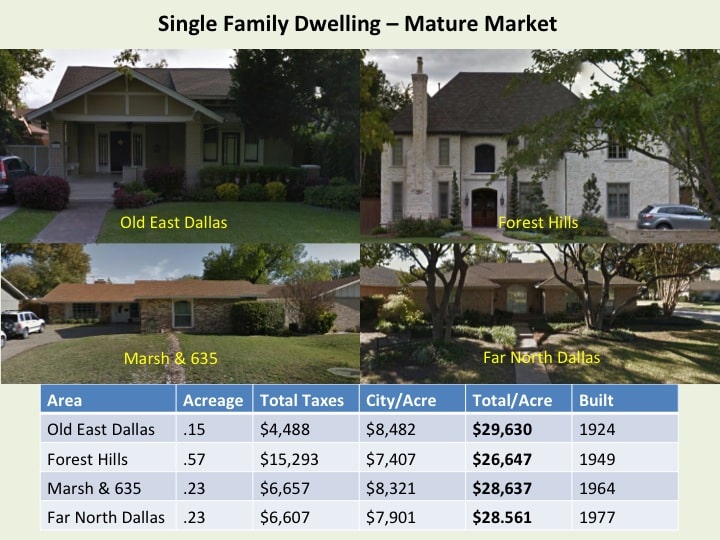
While this analysis shows different houses of varying age, size, and neighborhoods, the total taxes yielded per acre lie within the same range. This means that a stable, well-maintained, single-family neighborhood will perform at about $30,000 per acre annually. This estimated figure will serve as the standard for this observation.
Next, what if the single family neighborhood is not so productive?
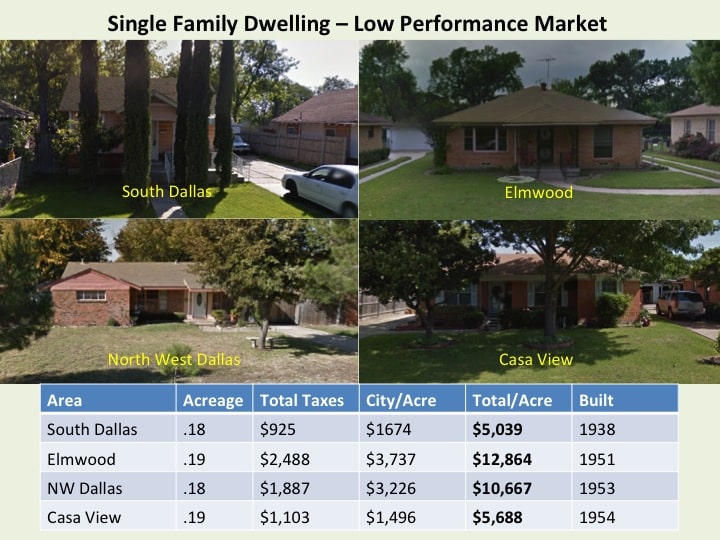
Total taxes paid and total taxes per acre are considerably lower in under-performing neighborhoods, yielding a fraction of the taxes from the areas above. These houses in this set are located at roughly the same distances from downtown Dallas, built in the same era of the 20th century, and reflect a very similar architecture.
Next, I’d like to show you the next incremental level of density: the duplex.
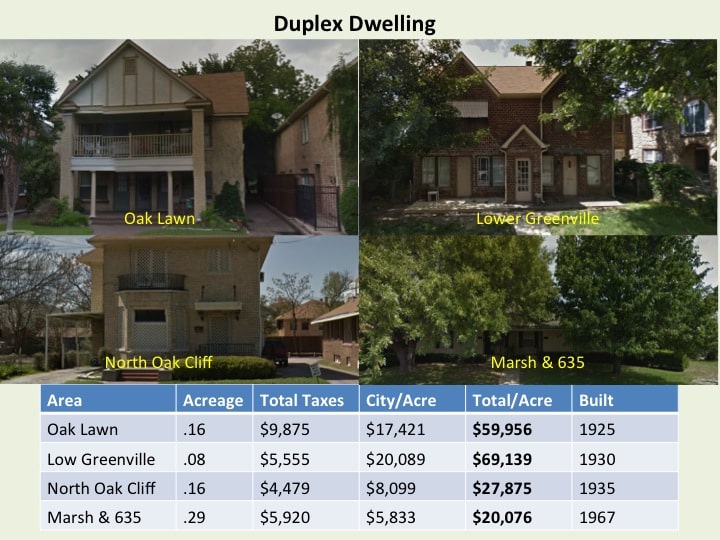
What we see is that the financial performance of the duplex is tied to the desirability of the area surrounding it. Density in an attractive area may double the value of the property, whereas density may have little effect in an area that is not desirable. In other words, density for the sake of density is not necessarily a strategy that yields the city a high return on investment. On the other hand, strategic planning and architectural design can make even the smallest plot of land very valuable to the city.
And what about large multifamily developments of at least 300 units?
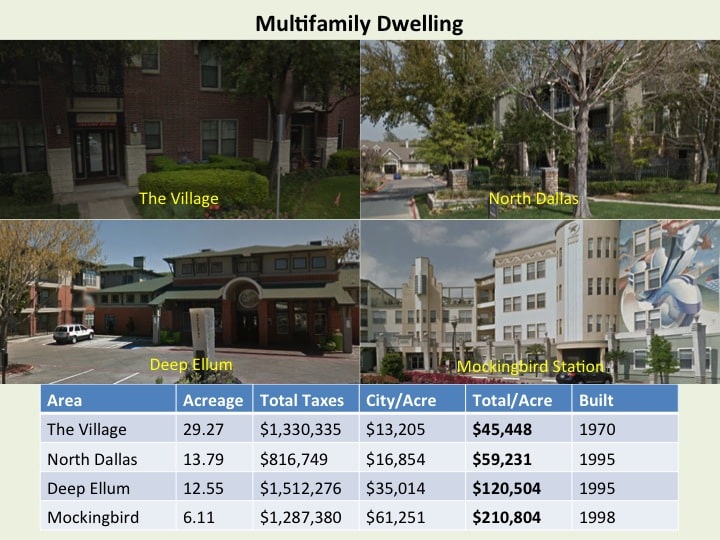
Here we see the same trend with large multifamily. The more desirable the area, the stronger case for density. The developments in Deep Ellum and Mockingbird Station are adjacent to DART Rail lines and entertainment, which make them financially productive, desirable residences. The data shows us that sprawling apartment complexes may be an efficient way to house hundreds of people, but they aren’t necessarily the most efficient use of space, especially as they age.
In the next post, we will take a look at the financial productivity of commercial spaces that influence the residential areas surrounding them. The businesses located in an area can help to differentiate a neighborhood and influence its desirability. How do commercial strip centers affect a neighborhood? How well do the oldest developments in our city perform financially?