
Development in Dallas–Fort Worth hasn’t slowed down much in recent years, and that pace shows up in procurement in a specific way: teams sourcing specialized finishing materials, natural stone included, are increasingly looking past local distributor networks. They need volume. They need lead-time control. Local inventory alone often can’t deliver either at the scale a hospitality or commercial project demands. Which raises the real question developers should be asking — not “who’s cheapest per slab,” but which supplier actually reduces risk over the full life of the project.
Why stone sourcing matters in modern development projects
Where material quality shows up in a project
Stone doesn’t hide. It ends up on facades, in hotel and office lobbies, on kitchen islands across a multifamily build, on feature staircases — exactly the surfaces people notice first and forgive least. A design can look perfectly cohesive in renderings, and then six months into construction the second-phase material arrives looking just slightly off from what went in earlier. That gap is rarely dramatic. It’s just noticeable, and noticeable is enough to be a problem on a commercial-scale finish.

Common sourcing challenges developers face
In Dallas–Fort Worth, many hospitality, mixed-use, and multifamily developments are completed in multiple phases. This often means materials need to be reordered months after the initial purchase, making consistent supply from the same source essential.
The issues that actually cause delays aren’t usually visible at the point of purchase. Veining and color mismatch between batches tends to surface on reorders — the original run looked fine, but the follow-up material doesn’t quite match it. Availability of large-format slabs can be inconsistent, especially for less common stone types. And delivery delays, once they hit, don’t stay contained; they push into fabrication scheduling, then installation crews, then whatever trade is lined up behind them. None of this shows up on a spec sheet. It shows up three months into a project, usually at the worst possible time.
Buying direct from a manufacturer vs. working through a distributor
How the supply chain affects cost and consistency
Distributor markup is real — nobody’s disputing that. But treating it as the main issue misses the bigger point. Every intermediary between a quarry and a job site adds distance: from the raw material itself, from the production schedule, from whoever’s actually deciding how consistent one batch will be against the next. That distance, more than the markup itself, is where sourcing risk tends to originate.
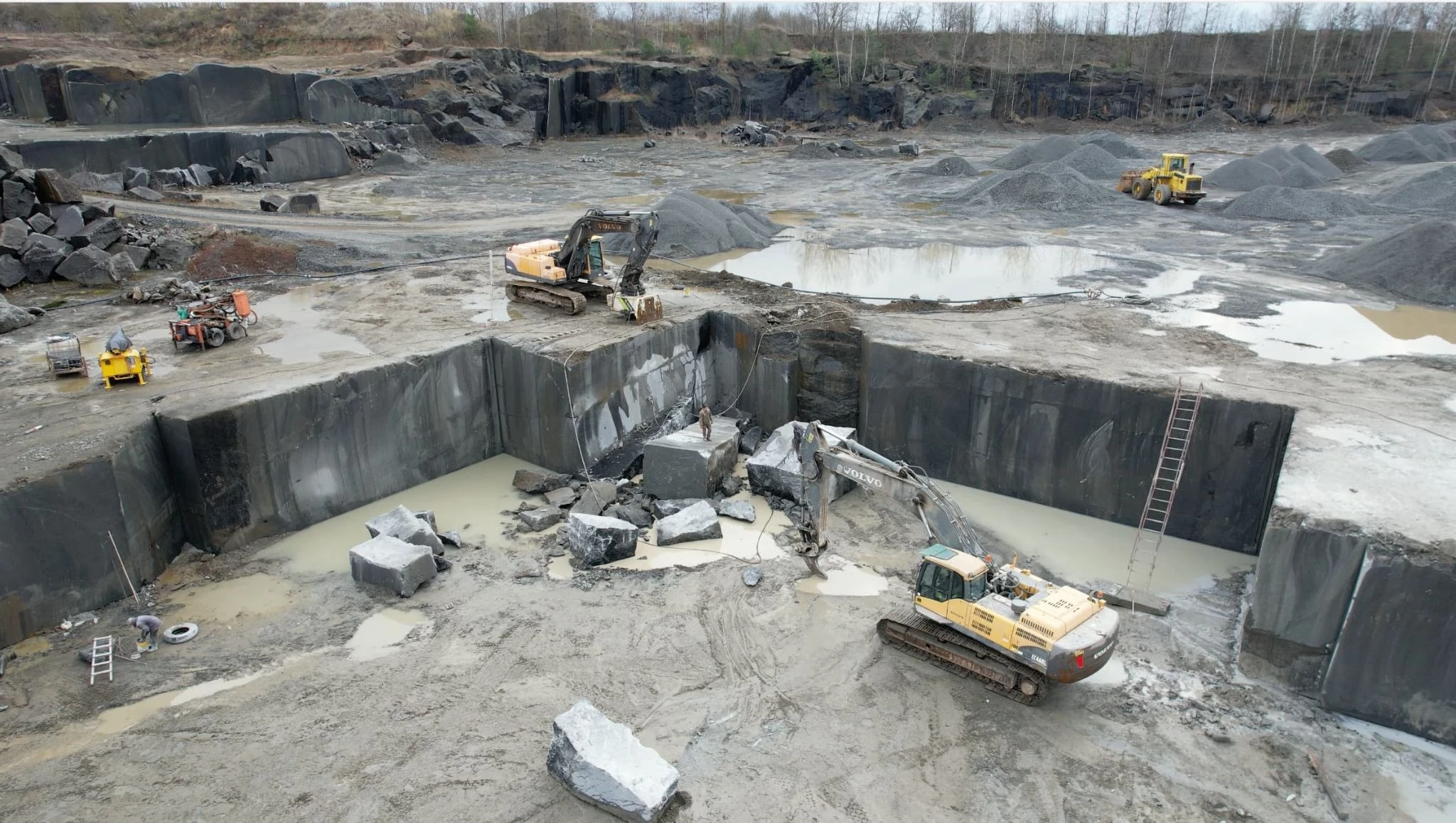
Sourcing directly from a manufacturer shortens that chain. Quality control happens closer to where the stone is actually cut. Supply stability becomes something a developer can verify rather than take on faith. And there’s simply more visibility into where the material came from and how it was processed — which matters more than it sounds like it should, until a batch doesn’t match and someone needs to figure out why.
Developers evaluating suppliers often gravitate toward manufacturers that own their own quarries, mainly because ownership translates into control — over raw material quality, over production consistency, over what’s actually available when an order needs to be placed. Golovinski is a useful example of this vertically integrated model: large-format slabs, including black labradorite granite, supplied directly out of a stone processing factory rather than passed through a chain of distributors. That’s a meaningfully different level of visibility than most supply chains offer once several intermediaries are involved.
Why large-format stone slabs improve project efficiency
Large-format slabs solve a few problems at once. Fewer seams mean cleaner visual continuity across a big surface — a feature wall, a long run of countertop — where every seam is a place the eye can catch on. Less material gets wasted in fabrication too, since a fabricator working from a larger slab has more room to cut around flaws or hit unusual dimensions without excessive offcuts. That extra room also gives design teams more latitude for layouts that don’t fit neatly into standard slab sizing.
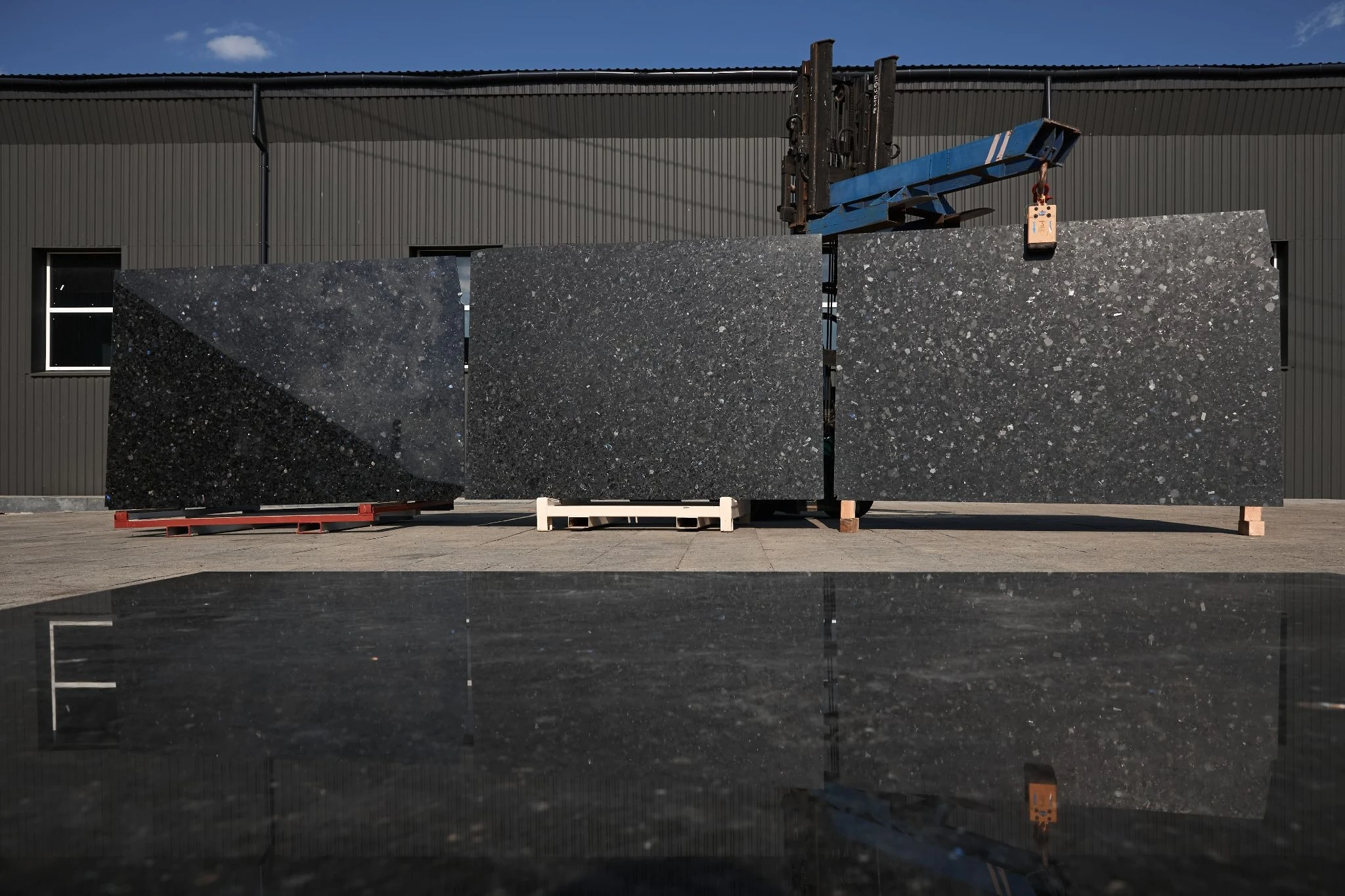
These larger formats show up most often in countertops, wall cladding, feature walls, and flooring — again, the areas where any inconsistency is hardest to hide. Thickness varies by application: thinner cuts for countertops, heavier formats where the stone is doing structural or architectural work, not just decorative.
Why consistency matters across large projects
On a project working at commercial scale, uniform color and texture isn’t really an aesthetic preference — it’s closer to a functional requirement. A slab that’s even slightly off from its neighbor becomes obvious the moment it’s installed next to dozens of others, in a way it never would in a single-slab residential application.
This is really where a single-manufacturer relationship earns its keep. Change orders happen. Material gets damaged during installation. Projects get built in phases over a year or more. When more stone is needed later, tracing back to the same producer and the same production run gives a developer a real shot at matching the original material — something that’s much harder to pull off once you’re back out shopping a new distributor with an unfamiliar batch.
Questions developers should ask before ordering stone
- Does the supplier own the quarry, or are they sourcing through additional intermediaries?
- Can large-format slabs be supplied consistently across multiple orders?
- What slab sizes and thicknesses are actually available for this project’s applications?
- Can a future batch be matched to the original order if more material is needed?
- What lead times are realistic, given current production and shipping schedules?
Conclusion
The supplier a developer chooses ends up shaping more than material cost — it shapes project quality, how predictable the timeline stays, and how much risk gets quietly absorbed along the way. Working directly with a manufacturer that controls the full cycle, from quarry to finished slab, tends to mean fewer surprises for developers and contractors alike.