

Many Texans have received notices this month that their properties appraised much higher this year than last. Such increases often leave property owners expecting exorbitantly high property tax bills the following year, but an economist with the Texas Real Estate Research Center (TRERC) at Texas A&M University says that’s a misconception.
“Many factors complicate how property taxes are calculated, but by and large the increases in property appraisals being reported vastly overstate the average increases in property tax bills that should be expected next January,” said TRERC Research Economist Dr. Adam Perdue.
Texas’ appraisal districts are required to appraise all real property at fair market value each year, which Perdue said typically leads to manageable and understandable increases in tax appraisals. TRERC’s Texas Home Price Index showed a 3 percent average annual increase in statewide market value from 2007 to 2019, peaking at 7.6 percent between January 2013 and January 2014. However, in 2020 the average increase was over 9 percent, and in 2021 it hit a record high of almost 20 percent.
But in the case of such unusually high appraisals across the board, the appraisal process is only the first step in calculating the tax bill.
“The second step is deciding on the tax rates,” Perdue said, “and these are largely determined by the cost of providing voter-approved government services.” Tax rates are recalculated each year.
After giving property owners the opportunity to protest the initial property valuations, the appraisal district submits the valuations of all properties to the local taxing jurisdictions which then calculate a tax rate that yields the revenue necessary to continue running the government services voters have requested and approved.
“In an ideal scenario, where voters were happy with the previous tax bills and level of government services, even a 20 percent increase in average taxable valuations could be exactly offset with a 17 percent cut in the tax rate and yield the same tax bill for the same level of service, holding everything else constant,” Perdue said.
Perdue said many other complicating factors figure into the process. For example, the homestead exemption limits growth in taxable value to 10 percent per year, slowing the growth rate of homesteaded properties’ tax bills. An over-65 homestead exemption places a ceiling on the amount qualifying homeowners have to pay in school taxes (the primary component of property taxes).
“Relative differences in value increases will still impact your tax bill,” Perdue said. “If your value increased more or less than average, then your bill may increase more or less than average.”
He said property owners also need to remember that any tax rate that would increase total revenues from existing properties by more than 3.5 percent must be approved by voters under state law.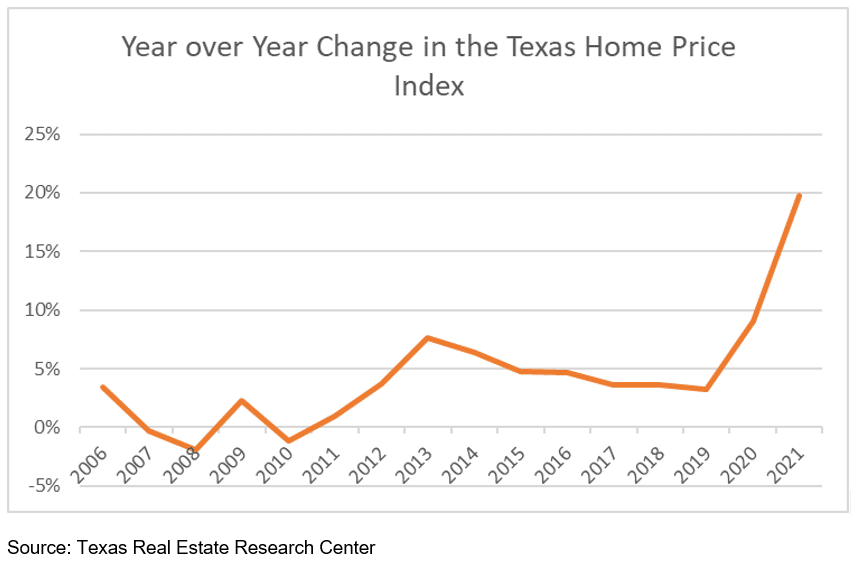
Funded primarily by Texas real estate licensee fees, the Texas Real Estate Research Center was created by the state legislature to meet the needs of many audiences, including the real estate industry, instructors, researchers, and the public.