
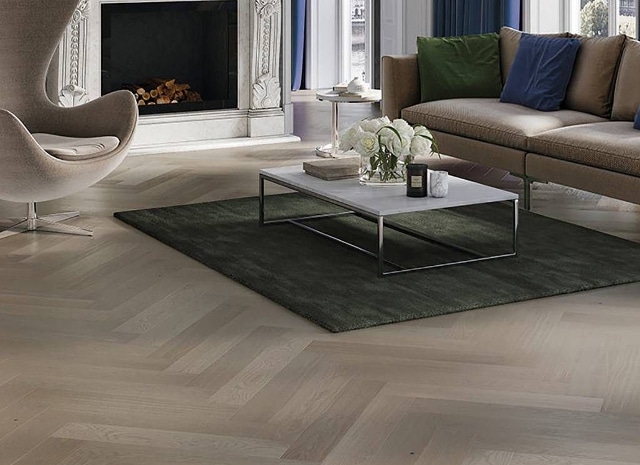
For the longest time, I noticed that some wood floors looked considerably different from others. At first, I chalked it up to perhaps being different species or different trees or luck. I will confess that until my Penthouse Plunge, I’d never installed hardwood floors in any home. My first house had Douglas Fir from the 1920s (quite soft and easy to mar). Others had their own original flooring until my Athena unit, which had multiple types of terribly-maintained engineered wood (and tile and carpet) that I replaced with engineered floors I really liked.
The Claridge’s price-point requires hardwood floors. And so I set off on a rock-paper-scissors exploration of wood species. There’s the oak family – red, white, and European – which to someone who doesn’t see red well, all look fairly similar except in graining. The European oak was definitely more “refined” grain (and price).
Then there’s maple, which tends to feel decidedly modern compared to oak’s more traditional feel. Hickory and pine target a more “country” feel, with cherry being obviously (to most) a red-toned option. From there, the options – from ash to wenge – are endless. Natural coloring is a continuum from light brown/tan to almost black and includes stops at orange, red, and fairly vivid purple. And whereas wood flooring of old tended to be from local species, they’ll cut down a tree from anywhere these days.
But the mystery that took a bit to crack was how (unstained) flooring of the same wood species could look so different.

Wood Grades and Saw Cuts
First, there are different grades of wood within a species. The grades reflect the knottiness (not naughtiness) and color variation of the planks. “Clear” is the highest grade with no knots and uniform color, followed closely by “Select and Better”. The more rustic options are #1 and #2 Common which add knots and sometimes quite large color variations. In some woods, color variations equate to differences between heart and sapwood (the closer to the bark, the lighter the tone).
But the mystery was cracked when I learned about saw cuts. I’d already been through species and decided on white oak for my side of the penthouse which was almost all carpet (lighter stains will show more red with red oak). At about his time, I’d visited the Hall Arts Residences model and really liked their straight-grained floors (also white oak). I didn’t ask about them, but the seed was planted.
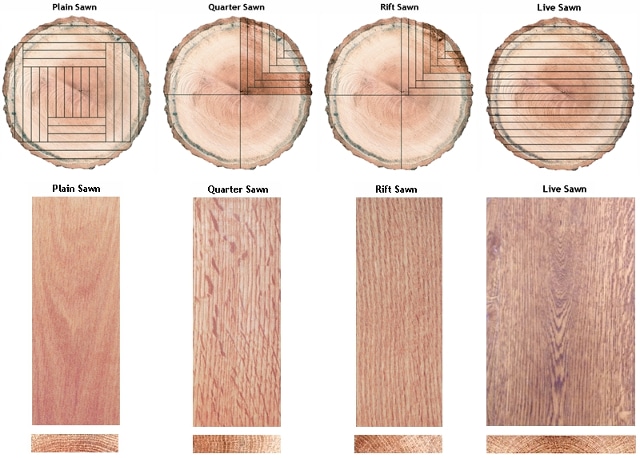
It was actually my general contractor who suggested “rift and quarter” sawn oak versus the standard “plain” sawn my flooring people had quoted. A quick pic on the smartphone intrigued me enough that I visited a couple of flooring showrooms to see the difference in person.
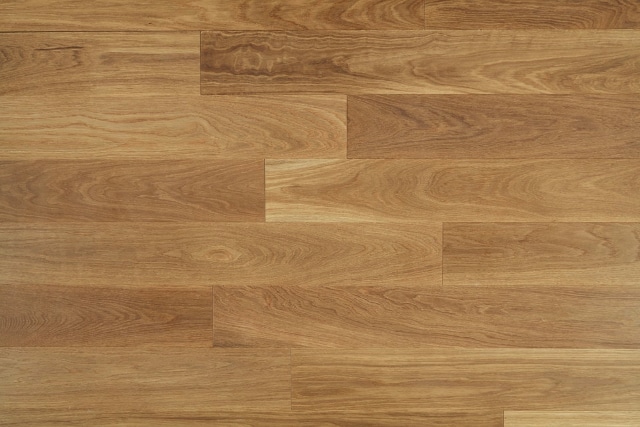
Plain Sawn
The most common and least expensive option is plain (or “flat”) sawn. As you can see above, the result is a wavy grain that it almost liquid. The grain can be more affected by temperature changes, moisture, and humidity with planks over five inches being more prone to crowning and cupping. One of the reasons it’s the least expensive cut is because there’s little waste.
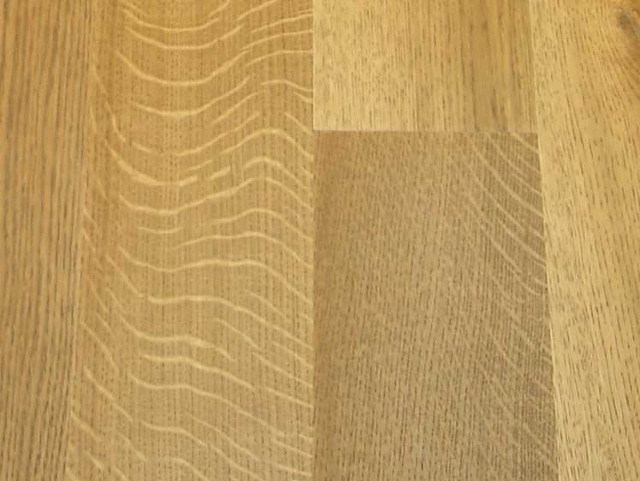
Quarter Sawn
I think of old furniture and Chicago bungalows when I think of quarter-sawn oak. Cutting the tree to produce quarter sawn means the cuts are not across the grain as in flat sawn. This produces straighter graining and some interesting character lines like tiger stripes called medullary rays whose function was to carry nutrients within the tree and block insects. They’re not always as pronounced as in the left plank above, sometimes it’s more subtlety diagonal like the board on the right.
Aside from aesthetics, you buy quarter sawn lumber because it’s more dimensionally stable, resisting warping, cupping and crowning. It does this because the end grain is pointed upwards, resulting in the “desire” to bend being only the thickness of the plank (3/4”) instead of its width (like plain sawn). Quarter sawn is a little more expensive than flat cut.

Rift Cut
This is what I saw at Hall Arts. Beautifully straight lines uninterrupted by knots, color variations, or tiger stripes. It actually reminds me of the Douglas Fir floor from my first house (and makes me wonder if it was rift cut). The Hall Arts model uses wide plank floors, which explains why they went with rift-cut flooring as it’s the most dimensionally stable to resist cupping and crowning. It’s also the most wasteful in production and the most expensive of the three cuts.
The most common “combination” today is “rift and quartered” whereby cuts of both varieties are mixed to offer the straight grains and visual interest of both. Of course, cost is a factor. For my white oak floors, moving from plain sawn to rift and quartered added about a dollar to the cost per foot (very worth it).
It’s funny, rift and quarter sawn lumber was quite popular in craftsman homes built between the 1890s and 1930s due to its clean-lined rebellion against the ornate Victorians (where American Craftsman homes copied the British Arts and Crafts aesthetic). Today, as more modern or transitional designs are more popular, rift and quarter sawn flooring is doing the same duty in simplification.

Bonus: Live Sawn
Remember those European oak floors I mentioned earlier? I couldn’t put my finger on why I liked the pattern. Turns out that in addition to being a different species, they’re “live sawn”, the simplest cut where the tree is sawn top-to-bottom like a (long) loaf of bread with no wastage.
Depending on the width of the planks, you can see all the other saw types in one plank. Essentially, the outer edges will be the straight rift and quartered whereas the center will resemble the more wavy grain found in plain sawn.
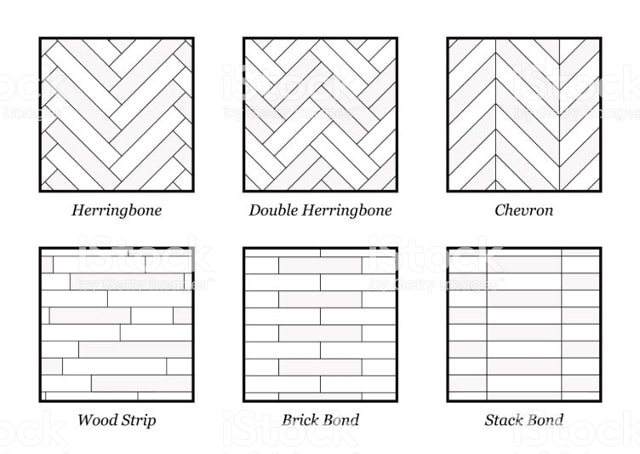
Patterned Flooring
A whole column could be written about the patterns used to lay out a floor (technically classed as parquet). Most people lay the floor in planks that go side-to-side across the widest part of the room. For whole floors and houses, the same direction will carry through the whole expanse.

For those with deeper pockets, there are no bounds. The images above represent a tiny selection of the different parquet patterns available. I would have loved to have used a herringbone or chevron pattern on my floors, but the increased cost for materials and labor doubled the cost – which wasn’t worth it considering how much of the floor would be covered in rugs. Of course in Europe, herringbone and chevron are so popular, you can literally purchase them at the local equivalent of Home Depot.
Flooring is one of those big decisions when building or remodeling a home. It’s literally what you’ll be standing on every day. What I found is that there are tons of choices that you receive very little help with unless you ask, ask, ask. In my case, I never considered that cutting a log in different ways resulted in such variation.
My prediction for 2020?
One thing we can all be happy about this holiday season is that hand-scraped (in a factory) wood floors are
D. E. A. D.

Remember: High-rises, HOAs and renovation are my beat. But I also appreciate modern and historical architecture balanced against the YIMBY movement. In 2016, 2017 and 2018, the National Association of Real Estate Editors recognized my writing with three Bronze (2016, 2017, 2018) and two Silver (2016, 2017) awards. Have a story to tell or a marriage proposal to make? Shoot me an email [email protected]. Be sure to look for me on Facebook and Twitter. You won’t find me, but you’re welcome to look.