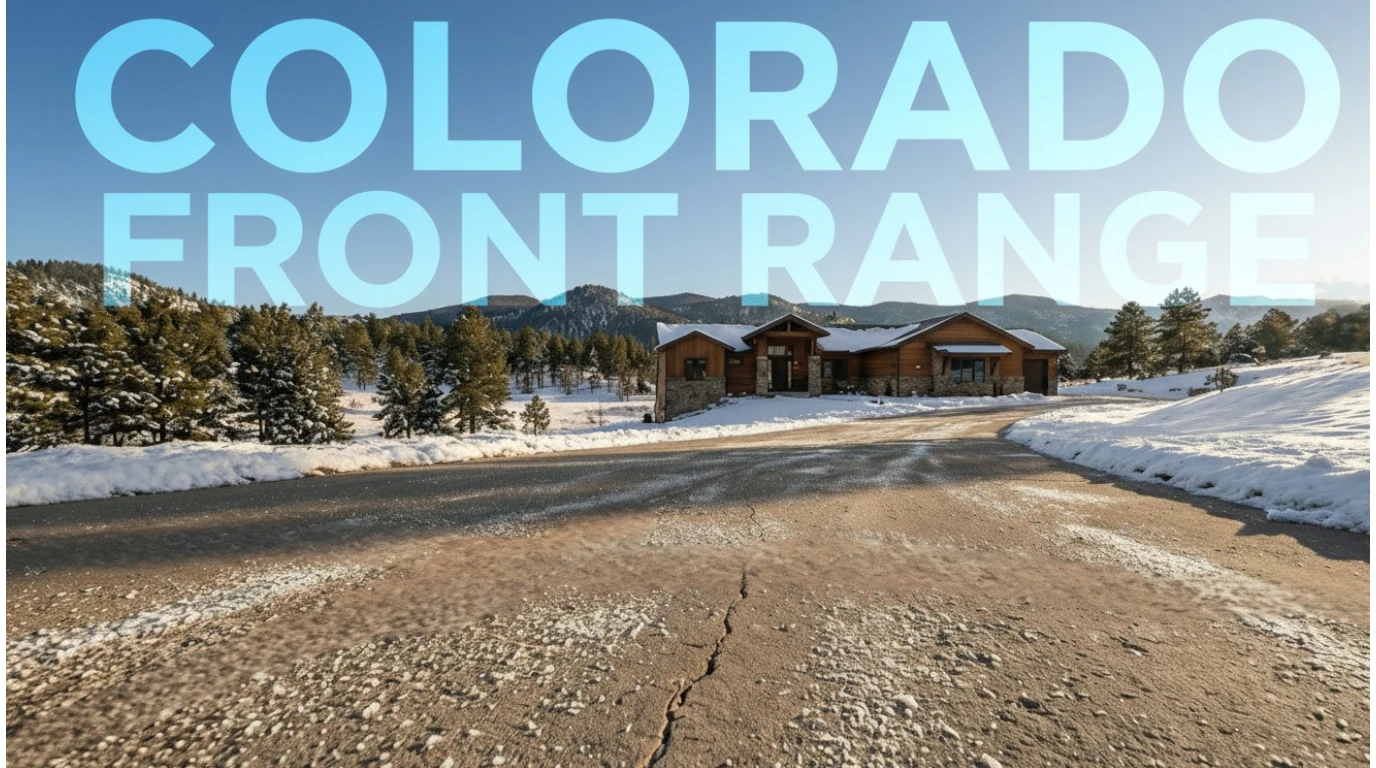
If you own property along Colorado’s Front Range, your concrete takes a beating from the weather, not just from traffic or heavy loads. Colorado’s freeze-thaw cycles are some of the toughest in the country, and they can turn a brand-new driveway into a cracked and worn surface in just a few years if the concrete wasn’t built for this climate.
Here’s what’s happening below the surface and what experienced contractors do differently to make concrete last in this environment.
What Freeze-Thaw Does to Concrete

Because concrete is naturally porous, even a well-finished slab absorbs small amounts of water through its surface and along its edges. In Colorado, that water freezes and expands by about 9% as it turns to ice based on data from the Portland Cement Association. That expansion creates internal hydraulic pressure that pushes against the concrete’s pore walls.
When temperatures climb the next day which happens frequently since Colorado commonly sees temperature swings of 40 to 50 degrees in a single day, the ice melts, the pressure releases, and fresh water seeps deeper into the now-slightly wider pores. Then it freezes again, and the cycle keeps repeating.
From Colorado Springs through Denver, the Front Range sees dozens of freeze-thaw cycles every winter due to those dramatic daily temperature changes. Over a few seasons, that can mean hundreds of rounds of microscopic expansion and contraction. Over time, this leads to three common types of visible damage.
- Scaling happens when the surface layer flakes and peels away to expose the rough aggregate underneath.
- Spalling occurs when larger chunks of concrete break off, often at edges and corners.
- Cracking means internal stress fractures work their way to the surface, allowing even more water to get in and speeding up the cycle.
This entire process accelerates when cities use de-icing chemicals like magnesium chloride during winter storms. These chemicals melt road ice even in sub-zero temperatures, meaning vehicles drag that salty slush right onto your driveway where it forces the concrete to absorb even more moisture right before the next hard freeze.
For property owners, this isn’t just cosmetic. Water can move through damaged concrete and reach the foundation, leading to structural issues and costly repairs. For real estate investors, damaged concrete flatwork is one of the first things buyers notice and one of the fastest ways to lose curb appeal.
How To Build Concrete That Holds Up
Concrete that’s properly specified and installed for Colorado’s climate can last for decades. The difference usually comes down to five factors that help a slab hold up over time.
1. Air-Entrained Concrete
This is the single most important defense against freeze-thaw damage. Air-entraining admixtures create billions of microscopic air bubbles evenly distributed throughout the concrete mix. These bubbles act as relief valves so when water freezes and expands, it pushes into the air voids instead of cracking the surrounding concrete.
The American Concrete Institute recommends a target air content between 5% and 7% for typical residential flatwork exposed to freeze-thaw cycles, though the exact value depends on aggregate size and exposure severity. Any reputable Colorado contractor should be specifying air-entrained concrete as standard. If yours isn’t, that’s a red flag.

2. Higher-Strength Mix Design
Standard residential concrete is often poured at 3,000 PSI but in Colorado’s climate, 4,000 PSI is a better baseline. A 4,000-PSI mix with a low water-to-cement ratio produces a denser and less permeable slab that absorbs less moisture in the first place.
The Portland Cement Association recommends a maximum water-to-cement ratio of 0.45 for concrete in severe freeze-thaw environments.
3. Proper Grading and Drainage
Even the best concrete mix can fail early if water pools on its surface or saturates the subgrade below it. Slabs should be graded at a minimum slope of 1/4 inch per foot to move water away from the structure.
The subbase material, typically compacted Class 6 gravel in Colorado, needs to drain freely so moisture doesn’t get trapped under the slab where it can freeze and heave.
4. Steel Reinforcement and Control Joints
Temperature swings cause concrete to expand and contract. Without properly spaced control joints, the slab chooses where to crack and it usually chooses somewhere inconvenient. ACI 302.1R recommends control joint spacing of 24 to 36 times the slab thickness.
For a standard 4-inch residential slab, that means joints every 8 to 12 feet. Rebar reinforcement like a #4 bar on 24-inch centers is a solid standard for residential work and helps hold the slab together structurally even if hairline cracks do develop.

5. Penetrating Concrete Sealers
Even with the perfect mix design, applying a penetrating silane-siloxane sealer gives the concrete a necessary final layer of protection. These sealers soak deep into the pores to create a waterproof barrier right inside the slab. This makes water and melted snow bead up on the surface instead of soaking in, greatly reducing the amount of moisture available to freeze and expand later on.
The Bottom Line For Colorado Property Owners
Freeze-thaw damage usually shows up sooner or later unless the concrete was built to handle it from day one. When evaluating a property’s concrete or hiring a contractor for new work, ask about air entrainment, mix strength, drainage planning, and protective sealers. These aren’t optional upgrades in Colorado. They’re the bare minimum for concrete that lasts.
About the Author:
John Richey is the owner of Creststone Concrete, a residential concrete contractor serving Colorado’s Front Range from Colorado Springs to Castle Rock. Learn more at creststoneconcrete.com.