
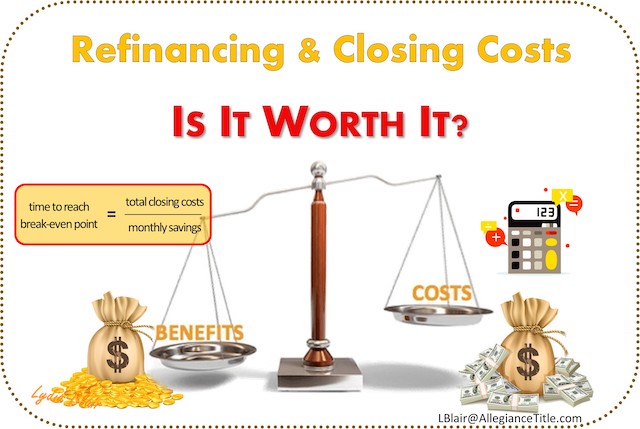
The refinance market is booming with homeowners taking advantage of record low interest rates. However, millions of homeowners are passing on the opportunity to save money by refinancing their current home mortgage. Many of those mortgage holders are just not sure if refinancing is worth it.
The Pros And Cons
Refinancing is replacing a current mortgage with a new one. The new mortgage loan pays off the old one, and the homeowner is then responsible for paying the new mortgage. There are significant time and costs associated with refinancing. It can save a homeowner money or cost money.
“Any determination of whether a borrower should refinance is dependent on whether or not the transaction creates a tangible benefit,” says loan officer Alison Hannah, Vice President of IberiaBank.
Do The Math – Consider The Fees
Closing costs are an important factor in deciding whether to refinance. Like an original mortgage, refinancing requires a title search, credit report, appraisal, application fees, recording fees, tax certificate, and title insurance. Costs can also include an origination fee, processing fees, and more. Refinance fees and closing costs can add up depending on the loan amount, discount points you may buy, and what the lender charges.
Total closing costs typically amount to 2 to 6 percent of the new loan amount. According to Freddie Mac, the average closing costs on a mortgage refinance are $5,000.
In December 2020, the Federal Housing Finance Agency plans to add in a refinance fee of 0.5 percent of the loan amount to all refinance loans sold to the government-supported entities Fannie Mae or Freddie Mac. That accounts for about 70% of all U.S. mortgage loans.
A lower interest rate might not be worth it if your savings are consumed by fees and closing costs.
How much should mortgage rates fall before you think of refinancing?
Many experts recommend refinancing when it would reduce an owner’s interest rate by 1 percent or more. Every refinance has a break-even point. That is a point in time where your refinance pays for itself.
“The cost to refinance must be recovered via the reduced payment in a short enough period of time so as to make sense with respect to the borrower’s holding period,” advises Hannah.
To determine this, divide your mortgage closing costs by the monthly savings of your new mortgage. If you are paying $5,000 in closing costs and will save $200 per month because of refinancing, it will take 25 months to break even.
Break-Even Period on a 30-Year Mortgage

Use a mortgage refinance calculator to enter your current interest rate, monthly payment, and your new loan terms and calculate how the two mortgages would compare. If you do not plan to keep your home past the break-even point, it does not make sense to refinance.
Every homeowner’s financial needs and goals are different. A 1 percent interest rate decrease may offer significant savings on a $1 million mortgage but not make financial sense for a $100,000 mortgage.
Getting a Mortgage Can be Complicated
The refinance activity this fall has been a rollercoaster pattern of increased refinance application volume followed by a dip in requests. Forbes Advisor published a survey in October 2020 stating that about 32.4 million homeowners have a home loan with a 0.75 percent higher rate than today’s average mortgage rate. That represents about three out of every four mortgage holders with a 30-year mortgage.
Not all of those homeowners are eligible to refinance due to their income, employment, credit scores or home value. However, there are millions of qualified homeowners who could save hundreds of dollars a month on their house payments. So why isn’t everyone doing it?
Many homeowners do not want to go through the hassle and the paperwork that refinancing requires. The process can be daunting and not everyone is prepared or willing to jump through the hoops. They forget that the lender is handing over a big sum of money and even the most loyal clients carry a risk for repayment. Be prepared for the significant time and effort involved in refinancing.
Do Your Homework
When it comes to interest rates and closing costs, mortgage lenders take into account credit score, income, assets, loan amount, and property value.
Know your credit scores since they affect your interest rate. The higher your credit score, the lower the interest rate. Many lenders recommend a credit score of at least 720 to qualify for the most competitive rates. Consider taking steps to improve your scores before refinancing.
If you are unsure about refinancing, choose a knowledgeable mortgage lender who can help you decide. Know what costs to expect and whether it makes financial sense for your situation.
The opinions expressed are of the individual author for informational purposes only and not for legal advice. Contact an attorney for any particular issue or problem.